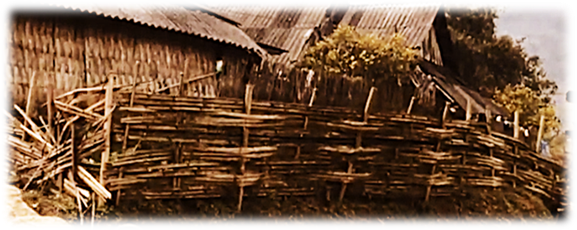
“Medic! We need the medic up here for Duquel,” yelled Lieutenant Jeremiah Piper at the top of his voice. Thick sweat ran down his blondish eyebrows and face. He had finally reached the village plateau overlooking the gorge, which camouflaged Bao Cat from the outside world. He made several attempts to approach the seriously wounded Duquel. Sniper bullets held him back behind the boulders.
“Rawlings, get up here, guy,” Piper called out at the top of his voice, yelling for the combat medic. “And you, Thibo, get that radio up here, too. Hurry Up!”
Shielded by huge basalt rocks, Piper ordered the platoon to position itself north and south of the hamlet’s perimeter. It was not immediately clear to Ulises whether the troops were being positioned for defensive or offensive action. He noted that sniping shots and screams broke the silence of early morning, which had made possible the impromptu, silent creep, up the ridge for the assault on the isolated enemy commune.
None of the troops knew what to expect in such a tranquil spot. Duquel saw a bucolic hamlet, hopefully with dwellers shying away from civil war and Saigon’s political follies. Some placid water buffaloes or a wayward elephant here and there. Most dangerously, he figured, a tiger might be lurking in the bushes. Bamboo vipers, swarming beehives, or stinging scorpions hiding under the wet rocks lining the village stream. He expected anything except a hail of Viet Cong bullets.
Duquel tried to hail Piper, who by now crouched behind a deformed rock some 15 meters behind, dodging ricocheting bullets aimed at his head. Piper could not hear him, so Ulises tried to utter a few words. He shrank his diaphragm muscle and moved his tongue and lips in unison. It was a strenuous effort that did not produce a voice.
“Don’t bring Rawlings to me. He’ll be shot.” Ulises vocalized to himself in a hoarse, blood-drenched speech. A new desperation set in. It was not so much because of his difficulty breathing. It was more about having no sense of control over his situation. A third sniper bullet struck his canteen sideways. Water poured out. Ulises felt it and thought he was hemorrhaging blood from his lower body.
Damn, he thought. It only takes a half-inch slug of cheap lead to alter life. Twist a fate. Misalign an existence. Again, time began to shrink in his mind. Days became seconds, weeks turned into moments, and years morphed into memories.
Months earlier, Captain Cardenas put together plans for the platoon-size combat operation to “poke around” the environs of Bao Cat. It was to be a recon patrol with only light rifle armament. The captain included Duquel in the expedition for the specific purpose of retrieving documents and insurgency paraphernalia which may be discovered in the hamlet. Duquel would take photographs while the platoon snooped around for a while. Cardenas ordered Castel, the troop cartographer, to make a realistic map of the village.
After the operation, all would return to a predetermined clearing in the valley for a helo pick-up a day or two later. Cardenas’s operational style was about scary tactics and gathering precise, swift, and neat field intelligence without the least bloodshed possible. Orders were to avoid any clashes with enemy forces. Aerial images of the Bao Cat from a week before by Cayuse pilot Amador showed no human activity in the hamlet before and during the mapping flights. Vietnamese intel officer Lieutenant Boi Pham Nguyen theorized that the VC only used the small village sporadically as a lookout spot into the valleys below or that it sat over a deep complex of tunnels that crossed into Laos territory. All village life might be below ground, as in Cu Chi.
At best, Bao Cat was a mere rest spot for local peasants during harvest time or for weary North Vietnamese infiltrators during the dry season in the highlands. But Duquel knew that quietly, Cardenas expected to find tracks and clues in Bao Cat that would lead to Quyet Thang’s where abouts.
Although not an infantry officer, Lieutenant Piper volunteered to lead the expedition only if given adequate attack weapons in case of an ambush. His ordnance officer instincts proved correct.

Trekking up the Annamite cliffs took six days through lush forest in the unfriendly territory until they walked into the Bao Cat trap, with nowhere to retreat. Following the antique map provided by Cardenas and his proxy of metaphysical informants, Tango platoon first reached an abandoned Buddhist temple in the lowlands, south of the A Shau Valley. They set up a base camp on the eerie site. Close by to a Vietnamese ancestral cemetery.
Orders were to scout the dense surrounding forest for guerrilla hideouts and then, by dusk, withdraw to defensive positions around the abandoned sanctuary. The main objective was to give the new troop unity of action and spirit-de-corps. Make the unit combat operational for the later assault on Bao Cat.
US military nomenclature designated this area as non-friendly. In Duquel’s anthropological mind, the site reeked of Vietnamese religious antiquity and colonialist strife. He would have gladly lingered there for an entire year deciphering the spot’s ambiguous existential clues, documenting the perennial Vietnamese historical struggle for national identity amid its heavy religious and political ballasts. He promised himself someday to return to the same spot someday, if war did not do him in.
The crumbling temple existed for over a millennium. The cemetery was a contrast. Evidence showed that during the French Colonial Era of the 1950s, Catholic migrants escaped from Communist North Vietnam after the nation’s partition. They set up an enclave around the temple ruins and foraged the surrounding forest for food and wood. They also worked as indentured labor in the colonial plantations of pineapple, cashew nuts, coffee, and rubber. Supported by the infamous Ngô, Đình Diệm regime in Saigon, the migrants took over the ancestral Buddhist grounds. Violence ensued between usurpers and the old, traditionalist residents, about to be displaced. The strife filled the cemetery with the human spillage of religious and political tensions. Ulises remembered how, upon arrival at the Bivouac site, the sensitives among the Tango Troopers quickly perceived strange energies of a violent past. Their paranormal faculties awkwardly began to awake.
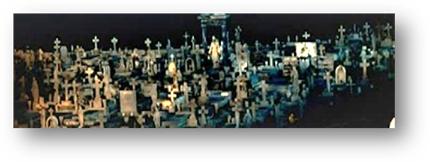
The first alarm came from Papio Pinay, the platoon’s Voodoo dabbler. He broke out in a cold sweat as he stared around the vicinity, stopping his gaze at the nearby cemetery tombs.
“Fuck this, man! Nam is at war everywhere. In the rice paddies, the city streets, and the cemeteries. I feel spirits here going at each other’s throats.” Though not a well-cultured man, everyone enjoyed his black humor.
When dusk arrived, Piper assigned the gunner to guard the left cemetery flank by the oldest tombstones. These dated back to the 1940s. During that time, the Viet Minh insurrection flared up against the returning French colonizers right after the Japanese retreat. Papio spent five hours gazing around his new neighborhood. He described mortified spirits protesting the troop’s presence in the graveyard. He insisted he detected ghostly skirmishes in the deep forest. These were between Buddhists and Christians, trying to outwit each other to access the temple grounds.
Radioman Thibodeaux, a devout Catholic and not a superstitious man, took out his rosary beads from inside his shirt. He prayed during a C-ration breakfast of cold frank and beans. Infantry scout Ferdinan Castel, the full-fledged santero since his youthful days in Guanabacoa, Cuba felt blasts of cold plasma running up and down his spine. This happened the minute he arrived at the burial ground. Piper and Buck Sergeant William Espino did not take the testimonies in earnest. Yet, Duquel made notes of all observations as ordered by Captain Cardenas.
Duquel recalled how the platoon’s bushwhacker and K-9 handler, Tobias “Tico” Dacosta, sensed aromas of aloe wood incense. Heard chiming sounds emanating from the temple stones in his head. He swore the stone altars hummed with a bizarre frequency. This was of interest to Duquel, yet his friend could not precisely explain the nature of the sensed vibrations. That was one of Cardenas’s bigger frustrations with his Tango Platoon. None of his metaphysical soldiers understood or knew how to use their faculties for adequate military intel.
Specialist Tico was known for smelling sounds and tasting colors. In his logs, Cardenas described Dacosta’s abilities as a dowsing mind capable of detecting quartz-like vibrations in objects and landscapes. Duquel noted that as he neared the temple, Tico pulled out a wad of Costa Rican forests sacred sage. He carried it in his fatigue’s pockets to guard against negative vibrations.
To Duquel, all that esoteric rigmarole would have been a work farce. But, upon arriving at the temple, he felt bathed in peace and sanctity, contrary to his flustered buddies. He thought about what Cardenas had written about each soldier’s faculties in his logs. The captain diagnosed that Duquel’s ESP abilities as post-situation. Duquel could relive past events with precision while aloof from the present moment. Ulises later discovered this was one of Cardenas’s many disappointments. Tango Troop’s ineffective abilities for the Thang mission utterly upset the captain. He remembered a conversation with the officer about such frustrations.
“I need soldiers with the skill to remotely sense a location, or to capture present events that would give clues. This is now called remote viewing.”
You are probably referring to psychometry, Sir” countered Duquel.
“Whatever. I need my men to capture information by touching objects belonging to a person. A piece of clothing, a map, an old travelogue or diary.” The captain showed Duquel some old captured diaries of a Viet Minh cadre that once operated out of Pleiku.

He was persistent in locating Thang’s whereabouts by tasking the magus troop with picking up psychic vibes or impressions. It was a pretentious quest. Too otherworldly even by the bizarre practices of the covert Vietnam Studies Operation Group in Saigon. But Cardenas insisted on the possibility.
At the temple site, Duquel surmised the astute captain intentionally chose the abandoned graveyard by the temple for a bivouac. It served as a test to fine-tune Tango platoon’s extrasensory perceptions while under the duress of having infiltrated deep into enemy territory. Days later, Cardenas visited the camp site by helicopter, and after reading the notes Duquel put together, he finally beamed excitedly.
“Aha! The extrasensory insights of the men overrode any fears of ambush. I was worried that vigilance and survival instincts would numb their ESP perceptions.”
♠
 Saigonsong.com - A Vietnam war novel - Rafael Matos