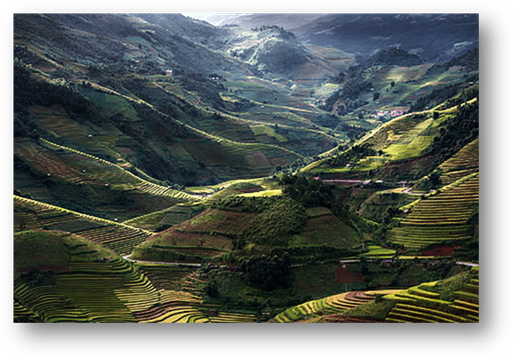
Much of Ulises’s short soldiering life took shape at the thunderous Rumba Hill with its constant artillery barrages and gunnery testing. The mount lay dead center among a strip of hillocks and valleys between the coastal towns of Chu Lai, Tam Ky, and Da Nang.
Far to the west was the Annamite Sierra, nestling the remote A Shua Valley, and further south the embattled Pineapple Forest. Rivers, rural roads, and many unpaved trails crisscrossed the landscape. Huge and small tracts of rice fields, dikes, and cultivation terraces carpeted the terrain at the edges of the outlying forests. To a skyscraper gringo soldier, the woodlands appeared as impenetrable jungles from distant African terrains. The Latino troops felt more homy with the vegetated lay of the land, relishing the papaya trees, banana lanes, lemon orchards, and the coastal palms with their watery, syrupy coconut fruit. Soursop fruit, cassava roots, immense taro leaves by the marshes, and riverbanks seemed delectable.

Ancient villages pockmarked the hills looking west to the Laotian border valleys. Tranquil water lakes lay around the lowlands, where the guerrillas set up small, hidden camps to replenish, rest, and bathe. On the reverse slope of Hill 54 were the coastal cities. Impromptu, shanty pleasure villages sprang up continually around the American fire support bases. These camps constantly spread deeper into the Viet Cong-controlled forests of the highlands.
The newer US-military-induced hamlets provided laundry service, cold refreshments, beer, or commerce of the flesh. At nightfall, they became ghostly vacant. One or two enterprising huts stayed alive after dusk, using rustic, noisy, smelly kerosene generators. A few incandescent bulbs glowed inside the huts where a pimp might watch over its bunny hooch. They also powered portable Victrola music.
Cardenas and the artillery officers kept the villages off limits at night. This did not inhibit the riskier infantrymen. Nor did it stop their sergeants from skipping over or slipping under the wire at safe spots along the perimeter.

Early after moving to the Hill, Ulises recalled the first and only visit Colonel Maguire paid to the Tango Company’s camp. In Duquel’s eyes, it seemed a courteous gesture and a small deference to Cardenas. The captain had obstinately kept away from the commander’s meetings since the last tense exchange with the brass at Da Nang. He did so even after the conversation with Father Santangelo.
Gallagher arrived on a shiny Huey chopper with door gunners on each side. It had the markings of the newly branded First Air Cavalry. The unannounced visit came after an early morning conclave of colonels at the Phu Bai Airbase, some 20 kilometers northwest. Radioman Thibodeaux alerted the captain of the visit. He received Maguire at the small earth landing zone near his hilltop bunker. After the dust from the rotor blades settled, Cardenas noticed Lieutenant Piper also dismounted. He carried a duffel bag. Cardenas stared disconcerted.
“Let’s sit in your bunker for a minute, Captain. This will be a brief visit,” Gallagher announced. He signaled to the Huey commander to keep the blades rotating. Piper followed both officers and laid his bag and battle gear near the bunker entrance. Besides the sidearm, he also carried an M-16 rifle. Cadenas’s fatigues showed sweat and fray. His jungle boots were soiled and dusty. In contrast, the colonel and the lieutenant’s battle garb appeared prim, clean, and well-ironed. Their boots shiny.
“You keep the firebase quite safe,” complimented Gallagher.
“It’s been quiet up here this month, Sir. Tensely quiet.”
“Recent intel indicates the enemy seems to be repositioning its assets at key points throughout the First Corps area. Closer than ever to Phu Bai, Chu Lai, and Hue,” informed Maguire.
“True,” Cardenas replied curtly. “We’ve detected guerrilla movement of company size level at the southern edge of the A Shau Valley.
Maguire entered the bunker first and sat at the captain’s old chair by the improvised door desk. He hardly fitted through the low, narrow entrance. He took off the steel pot, revealing a well-managed silver-dotted crewcut. Piper stayed outside. Ulises watched the scene from the radio shack nearby, sitting atop the roof sandbags with Thibo, the radioman.
“I’ve bought you a reinforcement. Lieutenant Piper will join your troop as a logistics officer,” the colonel said unceremoniously.
Cardenas was blunt. “I hope you don’t see this as a favor, Colonel. Excepting Corporal Ulises Duquel as a raw warrior, my team is comprised of only seasoned soldiers.”
Maguire glanced at Piper, who patiently waited outside under the afternoon sun, sweating under his pressed fatigues.
“The Butter Bar is young and just recently commissioned but smart as hell.”
“I don’t need him, sir.”
“I don’t have too long to stay, but let’s swing back a bit to our last conversation. I know you want to outfox the Viet Cong daredevils, Ruddy. But be prudent with your hustle.”
“And I know you are relentlessly pressed for high kill ratios, Colonel. However, in this unscripted conflict, it is even more prudent to cast aside certain conventional rules of war. A field officer must be his own tactical architect. There is too much at stake to do otherwise.”
“I must deal with a thousand tiny war fronts daily in Vietnam, Ruddy. I know you try to do your bidding based on experience. Again, remember that inverting the chain of command will impose severe accountability.
“I have my designs on how the field war should be conducted. You do, too, Colonel. The enemy surprises us every day with new tactics and ruses.”
“I strictly follow orders, Captain. And if you go rogue, I personally will go after your ass. No one in my operational area becomes a one-man blitz. We play teamwork here.”
Cardenas shook his head in defiance. “In this area of operation, we have one of the most lethal insurrection commanders watching our every move. Thang probably has the rank of colonel by now. He can heavily push the tide of the war against us in the highlands. Allow me to capture his gang. With that, I have accomplished my mission. Thang must be ensnared with whatever means possible.”
“This includes your magically brained soldiers?”
“Listen to this, Colonel. All this is still highly classified, but we’re almost there with the bait. Lieutenant Aznerz at Naval Intelligence in Saigon set up a portable machine. It sends signals via field telephone radio of our extrasensory geo-location captures. We are talking about rapid, actionable insights from this area of operation. A totally new technology.”
“What are these captures you refer to?”
“Our soldiers are training to perceive intense brain wavelength activity in designated spots. They aim to identify suspect Viet Cong cadres. These cadres attend diverse cultural venues to find new recruits and activists for the Liberation Front. We bring our music band to village festivals and university rallies. These covert cadres are unusually stressed, and their emotional energy multiplies. We try to sense their agitation–no pun intended—and single them out for recognition. Of course, we also do traditional field intel and occasional forensics on dead VC corpses for clues of military relevance.”
“Fucking, crazy shit,” Maguire commented.
“Aznerz’s analyzer will work with abstract field intel by translating it into geo-location data. Additionally, we input info from captured guerrilla pamphlets, propaganda graffiti, or internal messages in code. Add key agitprop words used in public discourse by the suspect Viet Cong agents. It’s a new field of military intelligence. Combines material evidence, discourse, and extrasensory perception. These elements are integrated into machines capable of interpreting data with specific type of artificial intelligence. All this takes place silently and beyond any killing field.”
“It’s all jabber to me,” said Maguire with his invincible blue eyes wide open. “Military pseudoscience. I sense no battlefield gain in any of this.”
“We are designing a new type of counter-intel, Sir, ” Cardenas said with poised courtesy. “We quietly blend into the adversary’s venues disguised as cultural ambassadors while secretly marshaling intel through mental sensing. Again, painless and without bloodshed.”

“Yeah, right. Some VC weasel will discover your game. Then you’ll all be executed with a pistol shot to the back of the neck behind the town’s market walls.”
“Every war action has its risks.”
“This is a never-ending debate, Captain,” Maguire said, staring hard a Cardenas. “You’ve got your orders cut, time and operational limits set. Get this mission done expediently but only in between search and clear patrols for our brigade. Piper is to liaise with us at Brigade Headquarters for coordination.”
“I already have Lieutenant Pham Boi as liaison. He ties in with South Vietnamese Army commanders, their intel officers, and the district chiefs, Sir.”
“I’m outta here, Captain. Do as I say.”
Maguire exited the bunker and signaled Piper over. The lieutenant grabbed his bag and walked towards his commanding officer. They exchanged a few whispers Ulises could not hear. Maguire boarded the helicopter, its blades already rotating for a takeoff. A whirlwind of dust and dry leaves enveloped the hilltop as it took off.
Piper stood at the bunker entrance and saluted. “Lieutenant Jeremiah Piper, reporting for duty, Sir.”
Captain Cardenas stared at the officer minutely and went to his desk to shuffle around some field maps. He noticed the Piper still carried a well-packed duffle bag on his shoulder.”
“Permission to enter, Sir. Reporting for assigned duty,” Piper repeated.
“Put the duffle down. On whose orders were you transferred to my company?” Cardenas asked suspiciously.
“I bring assignment documents for you to read, Sir. In private.”
Cardenas thought for a minute, exhaled loudly, and called over to Duquel. Once inside the post, he put his arm lightly over Ulises’s shoulder. It was an unusual paternal gesture.
“Drive over to the Military Police Security Detachment at Da Nang base. They’re waiting for you for a three-day personal defense and pistol training crash course. I’ve assigned you additional bodyguard duties. Grab some gear because you’ll bunk over there a few days.”
Duquel stared at the captain in surprise. In his mind, he was instantly planning visits to Kikei Santos at the morgue. He was also thinking of visiting her hooch by the nurse’s quarters. It was off-limits to male soldiers, but he had learned to squirrel in with his special ID card. Cardenas next pulled him to a corner of the bunker and lowered his voice.
“It’s going to be intensive training, so don’t fuck off. Always keep an ear open for me when you’re near people from headquarters. This applies whether you’re at the mess hall, PX, the NCO Club, or China Beach. Find out who sent this idiot savant over to my unit.”
Duquel lowered his voice even more. “Sir, in case you were not briefed, Piper was assigned to Tango Troop as an observer for Battalion Command. He understands Spanish and is on the same page with the colonels. I overheard some of their conversation last week when I delivered company documents. Morgue officer Santos later confirmed she saw Piper’s assignment in a classified report.”
“Fuckers,” blasted Cardenas. “They spite me and my intel operations but use the same tactics on me.” He shook his head towards the bunker door. “Get out of here. No, wait, I want you to meet our new liaison officer.”
Cardenas then turned to Piper. “Tell my company clerk what your charge will be in my troop, Lieutenant.”
‘I’m a Tactical Officer. I’ve been assigned to y’all to help with field operations and logistics. Sir, I prefer to discuss this in private.” Piper’s discourse took on a heavier Southern drawl, usually when he was tense or confrontational.
“You’re an Ordnance Officer. Why didn’t they send me an infantry Louie?”
“Your troop has a remarkable ethnic bent. With this idea of using Spanish in field communications to mislead Cong, the commanders saw fit I join your troop. I was raised in a Mennonite missionary commune in Nicaragua and am fluent in Spanish. My parents were Anabaptists who helped set up communes in Nicaragua. They first established at Bluefields. Next, they set up at Puerto Cabezas. Finally, they settled at the Mining Triangle on the north Caribbean coast. Their mission was to reach unbelievers and assist with violations of Indigenous rights. Was there until age 12.”
“So, I’ve heard,” Cardenas lied dryly and fell silent.
“Initially, as you know, I served as Aide de Camp to Colonel Maguire. However, he decided it was best for me to be at Hill 54. He wanted me to assist your troop in field operations,” said Piper.
“You still are an aide to Maguire. If you want to join my outfit at Rumba Hill, you already know I’m fighting a campaign of ideas. I got tired of fighting a war of bullets at Cu Chi. The more Viet Cong we killed, the more sprang up from the bushes and tunnels. We need to squash this rebellion in the bud by other means than buckshot.”
Piper stood pensive, staring at Duquel. Then replied slowly. “I know that the Military Assistance Command-Vietnam, Studies and Observations Group is about unconventional warfare. But this idea of spooking the enemy with spirits, using paranormal perception, is eccentric for me, Captain.”
Cardenas pointed to Ulises. “Dr. Duquel, here is my war investigator. He is doing fieldwork at the old French police archives in Saigon and Hue.”
Piper shifted uncomfortably. “This man, in the rank of corporal, is already in charge of sensitive material?”
“Duquel is a capable researcher. Carries a PhD in anthropology from Syracuse. Major Hines alerted me of his arrival at the Replacement Company a few months ago. I quickly snatched him for my mission.
Cardenas walked over slowly to Duquel. “How old are you, son? How long have you been in the Army? Why are you not commissioned?”
“Am 25, sir. Drafted in late 1966. Not good officer material.”
“Answer me in complete sentences, Soldier. Are you not a scholar?” ruffled Cardenas. He stared at Ulises up and down. Duquel knew he was putting up a stance for the lieutenant.
“He’s the courier our MPs see at the Monkey Mountain morgue frequently.” Piper tried to disguise the snitch as an observation. “Do you understand the captain wants a logical answer, Corporal?”
“Understood, Sir. My telegraph answers are for expediency.” And I do frequent the Morgue to deliver equipment.”
“I’ll agree to that,” said Cardenas. He swung around to Piper. “The corporal has top clearance for mission matters. Now, you’ve heard enough for today, Lieutenant. We need to keep classified matters under control. We’ve got prying eyes all over this base and its environs. You, Duquel, dismissed.”
Ulises left the bunker in a hurry. His mind was set on Kikei Santos. He wondered if the daily pistol training would be short enough for him to swing by the morgue. He sat in the jeep quietly for a short spell, trying to figure out his options.
Inside the bunker Cardenas sat at his desk and uninitiated his arrival talk with Piper. He lit a cigarette. “What more do you know about the Thang mission?”
“One of your men is the voodoo guy. Moises Pinay, I think his name is. He said you tasked him with listening to village spirit workers whenever he visited a rural area. He should pick up on any prayers or chants of protection for this Quyet cadre you’re chasing.”
“He’s not supposed to be talking about our secret mission.”
“In all honesty, I forced him, Sir. Pulled rank on him. I’ve also done some queries among the troop on orders from headquarters.”
“Then you know about my Tango Troop’s composition, lieutenant?”
“I do my research. When I learned about my assignment as platoon leader for Tango Troop, I studied.”
“Practice the strict military discipline you preach and wait until I brief you.”
“Oh, I expect that, Sir. I know practically nothing about this mission.”
“Briefly for now. I’m putting together a small army of intel scouts. Out to civic actions and expect them to merge with the locals, eyes and ears open. Sensory antennas up. Sniff out psychic clues. There will be some metaphysics involved.”
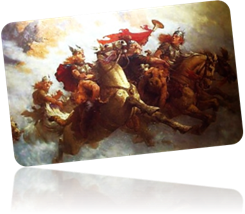
“I know you are a military history dilettante, Sir,” said Piper. “I would remind the captain that during the Nazi regime, Henrich Himmler infused the SS with pagan rituals. He used occult pageantry. He aimed to revive the warrior spirits of Germany’s mythological past. His charade turned murderous. His cultist practices created death-dealing SS troops imbued with supposed supernatural powers of ancient Aryan heroes.”
“It was for a different purpose, Lieutenant. Do a better read of your history. Himmler sought to revive tokens of German spirituality to aggrandize the German military machine. What the Viet Cong does is evoke their ancestral heroes. Infuse the insurrection with the zeal of past glories. In my mission, I am using this same folklore for counterrevolution. And I advise that if you’re not up to the task, request a transfer to a more conventional unit.”
Piper brushed his blondish hair with his fingers. “No. I’ll hang on. Competing viewpoints on strategy are good for military variation. I do recall well that American GI’s were ordered not to fraternize with the vanquished people in Germany. They were told the German population was the enemy, not friends. Here in Nam, there are many rural Victor Charlie sympathizers. Others are forced to be. We should not be fraternizing with them.”
Cardenas groaned. “You do know your World War II history. My mission goes counter to it. I prioritize civilian contact. Soak up the political intel and detect infiltrators. What other instructions do you bring to my unit?”
“Maguire wants all his troops in combat, Captain. The 3rd Marines Battalion we’ve replaced here in Da Nang has a thousand days in country, conducting over fifty major combat operations. We in the Army must supersede that bravado.”
“Are we now in a war Olympics with the Marines?”
“In my estimation, Sir, it’s about gallant rivalry. The Colonel wants to establish high Army competence in this operational area.”
“He’ll have his chance,” Cardenas affirmed. “There’s intel that the Viet Cong is shifting from infantry attacks to long-range mortar and rocket offensives. Aerial imagery and recon units have established the VC moving rocket launcher teams to Marble Mountain and Hoi An for attacks on the bases. Including sappers at the wire.”
“Powerful intel, Sir,” said Piper. “If any of it came from extrasensory perception, then I’m beginning to catch on”.
Good enough,” said Cardenas with a tinge of resignation. “Any other issue you need to bring up before I formally induct you into my command?”
“I hope for a frank and open communication with my Captain,” said Piper.
“You have it,” Cardenas said resolutely. “But let all criticism and viewpoints be constructive. We already have too many destructive agendas on our hands.”
“In that vein, Sir, I want to bring forward a perception about the quality of the Papa, Whiskey, Tango troop. Hearsay is that it has become a dump for wayward infantry soldiers.”
Cardenas lit another cigarette to once again hide his perpetual annoyance with the imprudent lieutenant. He struggled to keep his voice calm. It must have been 90 degrees Fahrenheit inside the bunker. He needed some fresh air on top of the hill. Piper had all his battle gear on, including the thick flak jacket. He did not seem to mind the heat.
“The PWT troop isn’t run-of-the-mill soldiery. All have past or present military battle experience and expertise. Everyone except Duquel, who is more of a deep garrison type. Maybe a few disciplinary problems with rifleman Raymon Galan, or medic Rawlings.”
“Bad fame also precedes your buck, Sergeant Espino,” Piper said with unnerving relentlessness. “His grunt peers profile him as a perilous squad leader. I hear that back at the Cu Chi operational area. They referred to his patrols as dead man’s platoon due to a high casualty rate.”
“The Buck leads men fiercely into the fray. He is a hands-on combatant,” minced Cardenas. “Any more observations?”
“No, Sir. With due respect, I will retire to my quarters in Da Nang for the day. You can assign me a new one up here at Hill 54 in the next few days. But I will say this, Captain. My family has all been in the military since the first Colonist-Indian war in 1676. I am a man of the uniform, as you are. We will surely understand each other in the days to come.”
“I expect so. We are true soldiers. I dream that if I die in the combat zone, I may be laid to rest on a funerary caisson. A caparisoned horse will pull it. A mule at least.”
“Good talk today, Sir. Frank and open. Can the Captain procure for me a ride back to Da Nang?”
“No, you will stay here already,” Cardenas said firmly. He wanted to eyeball the lieutenant from now on. “I’ll have my top sergeant set up a bunk for you. Cardenas rang up Tabal via intra-company radio.”
“Of course,” Piper replied. “I would be grateful if not too near the 155 Howitzers. The salvos shake the cot and make earplugs useless.”
Cardenas nodded. He had just the place for the new arrival. “Done. At 0800, after breakfast, PWT will be in front of my bunker. They will be ready for your presentation to the troop. Dismissed.”
Piper grabbed his duffel bag and marched out of the small command post. Tabal was already waiting for him in the Mule cart for the ride to the Butter Bar’s assigned bunker.
Ulises Duquel remembered how it all turned out for the new arrival. Piper settled into a comfortable, double-tier fortified bunker. It belonged to an artillery forward observer officer. He was killed the summer before during a patrol into the depths of A Shau Valley.
The bunker sat on a still forested spot of Hill 54. It faced east towards the coast, halfway to the mount top. Pier enjoyed an unstructured view and his spot was well protected. Only that it was surrounded by five camp latrines.
♠
 Saigonsong.com - A Vietnam war novel - Rafael Matos