
The Karst ridges near the Laos border.
Raw combatant Ulises Duquel became the first casualty of the assault on the lonely hamlet atop the Vietnamese cordillera. Seeing Duquel dying, Papio Pinay snapped out of his stupor. He knelt on one leg and let out a long blast with the M-60. The troopers behind him, still trekking on the upward rocky path, followed suit with blind rifle and grenade launcher volleys. Ulises heard the zoot-zoo-zoot of Jairo Jaramillo’s M-79, and the ensuing explosions behind the village pig pen.
Bullets flew all around the hamlet, some ricocheting off the volcanic boulders and others swallowed swiftly by the thin, straw walls of the huts. Clay pottery atop the central plaza benches shattered and split into fragments while straw baskets tumbled to the hard ground amid dust clouds. A hog, half its snout blown away by shrapnel, ran around in panic, squealing in pain. Chicken, geese, ducks, and an old rooster sought refuge in the thick shrubbery.
Duquel made another eyeball search, looking hard beyond the monkey bridge, eyes always on the lingering vultures. There was no sight of villagers anywhere. He figured the dwellers were by now deep in fortified trenches or tunnels. Their custodial guerrillas likely nested into sniping positions among the tree canopy overlooking the ridge. Instantly after the apparition vanished, Duquel felt a pang in his Adam’s apple. His throat felt incandescent. A dribble of blood burped out one side of his mouth. In his death throes, the bridled poet and song composer sprang loose this time with no music. Mere verse.
Just my luck. A fluid finale for this willing musician but reluctant warrior. My vitals ooze now onto a brook slithering out from the deep jungle. Collecting on the ridges and cascading to splash into the river valley below. Eventually, a lifeblood that will reach the South China Sea, diluting itself into the world's oceans.
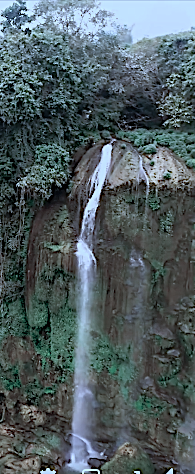
The mind of a damaged soldier becomes surreal. As words and images reverberated inside his head, Ulises tried to give them a cadence, rhythmic beat, a tempo. It was his peculiar way of being in tune with the world around him. Since childhood, he picked up on the tonal vibes of places, things, and people. Wherever he went, he heard the inner song of existence around him. At Bao Cat, amidst the chaos of battle, mental confusion, and soreness of body and soul, the sound of the nearby cascade felt soothing. A song of volatility. The essence of fate is in constant motion.
As he bled away, another melody thumped up from deep inside his entire being, in touch step with his wildly beating heart. It sought to escape from his broken voice box, express a sentiment. Only a muffled moan came out. He soon realized that this was a death chant trying to spill out. An ancient requiem of volatility a soldier hears when fatally wounded in battle. The essence of fate in constant motion.
As he bled away, another melody thumped up from deep inside his entire being, in touch step with his wildly beating heart. It sought to escape from his broken voice box, to express a sentiment. Only a muffled moan came out. He soon realized that this was a death chant trying to spill out. An ancient requiem soldiers hear when fatally wounded in battle.
He knew what this chant was. A weird, melodic mantra tainted with the Asian polyphony he so often heard during the Vietnamese cultural ceremonies and official acts he attended to as a military musician at Hue City, Da Nang, and at the Marble Mountain monasteries with monk Jampa Kochi. A lament about the futility of dying without wanting to fight. A chorus to the sagacity, the mastery of his Vietnamese warriors, singing about bullets with patriotic lethality,
Duquel yearned for his guitar. He needed to compose a new song, a battle hymn of victory inside of defeat. It would tell how Bao Cat, its jungle, and its warriors set up a funerary trap for the intrusive platoon, and an anthem to mutilated tree limbs and awaiting vultures, watery escarpments, and a pointless death. A dirge for a soldier poet dying far from home and loved ones.
He knew no other way of metabolizing the tragedy of the moment. Throughout his life, he took life’s tribulations and paradoxes and converted them into notes and melodic equations expressing sentiments, bygones, and tragic farewells. In a tempo of anguish.

Bao Cat was not a quaint place to die. Certainly, not by the foot of a crumbling bamboo gate and a derelict monkey bridge. A spot with no glory, strategic value, or operational validity. It is not even found in ancient Chinese maps of Vietnam’s long-forgotten imperial past. Ulises remembered the challenges the Tango Company faced establishing the hamlet’s location. That had been an ordeal. Hastily put-together operational maps by military intel and the aerial images were not particularly helpful.
Bao Cat was not even on the old provincial charts. Not only did old-timers in the Central Highland villages knew, or wanted to remember, the secretive village’s location. Only ancestral Vietnamese warrior spirits knew where the hamlet lay.
Zinged by the sniper bullet, Ulises Duquel remembered it all.
In despair, for lack of precise field intel, Captain Cardenas had no other recourse than to consult the Vietnamese spirit world. He would generate metaphysical data to use as intel material. During the summer of 1967, Boi Pham Nguyen, the captain’s South Vietnamese military aide, put together a séance to invoke the ancestral ghouls on the Annamite Sierra. Boi recruited his spiritist sister as a control medium to help deliver the other worldly intel the captain needed for his foray into the secretive Viet Cong’s political underground.
All is fair in war and conquest. Thus, Cardenas saw it fit to travel with Boi, his younger sister Thi Tai, to a tiny village deep inside A Shua Valley populated by folks who had lived through the first Viet Minh insurrection. Duquel went along to record the bizarre session with a notepad and a Nikon camera. At the village, the chieftain did not allow photographs, fearing they would end up in vengeful hands. The girl medium was able to consult the spirits of the elders still cavorting around the ancestral altars.
Tai fell into a deep trance, but no solid clue came through except colloquial advice from old village souls.
Boi translated the short messages spilling out of Tai’s almost numb lips.
“Harvest the rice at higher levels of the hills. Better crop yield.”
Cardenas became impatient. Pushed Tai into channeling deeper about which guerrilla organizations operated in the valley. Where were their hideouts?”
Boi’s face shriveled up in embarrassment. “Spirits only say villagers must use greener buffalo manure as fertilizer. Say plenty of good manure at Bao Cat pig pens.” Then there was silence from beyond the tomb.
Frustrated, Cardenas held another secret seance later that summer, this time in his bunker with his own Tango Company clairvoyants. Cuban Fernando Castel, the platoon’s Babalwo by trade in civilian life, fell into a trance while praying to his orishas. He pleaded his African demigods for protection while in Vietnam as an infantryman.
“Stay away from Bao Cat,” Castel mumbled in a gravelly voice.
Cardenas sprung up to attention. The familiar name came in again from the spirit world. “Give us more on this. What is your connection to Bao Cat?” he ordered Castel. The Cuban fell silent into a deeper sleep.
Next to him, voodooist Moises ‘Papio’ Pinay stated that the information came from another world Tu Tai, closely related to the ancestral Boi Pham Nguyen clan. Duquel recognized a Tu Tai as a Vietnamese scholar from the old imperial courts. The fact that Papio was unfamiliar with Vietnamese traditions and lineages gave the spirit message a certain authenticity. Enough to have Cardenas order Bao Cat’s location to be heavily researched.

Animist rituals in Vietnamese society did not intimidate Ulises Duquel. He held a doctorate in folklore anthropology and possessed an imaginative musical mind. On orders, he readily took on the task to research the supernatural cognomen manifested in the seances. He and Boi jumped head-on into old French intelligence chronicles. They carefully examined encrypted reports stashed in the long-ago shuttered Sûreté-Générale Indochinese prison basement. This basement was located at downtown Saigon’s old Rue Catinat Boulevard. Duquel discovered that Viet Minh prisoners gave the infamous French secret police torture chamber a sardonic moniker. They called it Hell next to Heaven. The colonial penal facility was situated near the majestic Notre Dame Cathedral. The faithful prayed while prisoners suffered.
After weeks of search, Bao Cat emerged from a hand-drawn map accidentally discovered by Duquel inside a rumpled-up personal rebel diary. It belonged to a Viet Minh militant whom the French purportedly executed at Con Son Island prison in the early 1950s. It took three Vietnamese interpreters, a retired French Secret Police agent still living in Saigon, and collaborators from the South Vietnamese intelligence services –all recruited by Cardenas– to figure out what the tattered map meant in a military context.
In the end, the final interpretation came from a shady informant’s testimonial once imprisoned at Rue Catinant. Additionally, a pair of old Viet Cong deserters confirmed passing by Bao Cat as a resting spot during a long infiltration trek from Hanoi to Pleiku through the Laos border. They remembered meeting National Liberation Front political cadre from the Viet Minh insurrection against the dictatorial Ngô, Đình Diệm regime. It was during the harried days of the final retreat by the French from Indochina after decades of cruel colonial vassalage. Late 1954.
As the torturous trail to decipher Bao Cat began to be cracked. Cardenas hastily began to set up a covert expedition to the guerrilla hideout. It all began in early June, just shortly after Ulises Duquel arrived in Vietnam. He was initially assigned to the First Corps Replacement Company at Da Nang Base. After two weeks of waiting for new orders as a US Army clerk, a short, muscular captain with a pockmarked face and stringy, jet-black hair approached Duquel directly outside the large building. Duquel was on cue for a miserable 12-hour shift of mess hall duty. Duquel initially mistook the officer for a Vietnamese commander due to his stature, small, slanted eyes, and high cheekbones. The ensuing conversation went fast and direct.
“You a musician?” Captain Ruddy Cardenas almost interrogated, staring hard into Duquel’s eyes
“An ABD in musical anthropology. All But Dissertation, Sir. The draft interrupted my thesis completion.”
“Are you a musician?” the captain repeated impatiently.
“I have extensive musical studies, Sir.”
“What instrument do you play?”
“Classic acoustic guitar and have dexterity in most Afro-Caribbean percussion instruments. Some piano. I also do musical arrangements and compositions. Have done ample research into musical annotation on the Indo-Asian genre…”
“I know about your academic background and research expertise. I need a clerk and also someone to organize a musical band in my infantry company. Set up a small ensemble to perform cultural events within the Vietnamese community. Provincial towns and rural villages of our operational area. My top sergeant, Tabal, will pick you up at 1300 at this same replacement depot with orders for your transfer to my camp in Chu Lai. You will be issued special clearance and a service pistol as my assistant. Go get your personal gear.”
Cardenas walked away without waiting for a reply. Duquel exhaled in exasperation. Military life offered no options. Only do as I say scenarios. But now he was secretly elated. He had just escaped kitchen police and long nights of guard duty by the wire. He was to transfer to what sounded like a barracks unit near Da Nang. He was to work as a company clerk and be a musician. Away from the messy and miserable life of Grunstville. What fucking luck!
He remembered how his new clerk duties began smoothly. Putting the band together did become a logistical challenge. Instruments were scarce. There weren’t many musicians at Hill 54, and most were Latinos with only artisan knowledge. He named the band Latin Son, transforming it into a ragtag Latin pop group to differentiate from the rock, country, and western troupes that usually toured the bases. Cardenas described the band’s primary mission as one to boost morale among his recently formed Papa Whiskey Tango combat unit. Also, to be part of cultural exchanges with Vietnamese civic groups in Da Nang City, Hue, and Hoi An. Tour villages near the artillery forward bases among the central highlands’ most contested battlefields. All as part of an official program to warm up rural Vietnamese minds and hearts to the American presence in their midst. A third darker, ominous mission for the band would soon ensue under Cardenas’s strict, watchful eyes.
Looking back at the singular events, Ulises Duquel recalled how Latin Son almost soon fell into articulo mortis. One of the group’s early and most extraordinary gigs occurred at a bizarre venue Cardenas set up for his Special Ops friends at the Saigon military headquarters at Tan Son Nhut Airport. The group performed inside a sandbagged pavilion with windows sealed, a room full of cigar and cigarette smoke, lights low, and all invitees in civilian dress. No details were given about the guests nor their patrons.
The South Vietnamese Officers Club hosted the soiree, only for special invitees. There, Duquel met Lieutenant Boi Pham Nguyen for the first time. Boi’s hobby was studying traditional Vietnamese musical instruments, so they clicked well together. Soon thereafter, the starchy South Vietnamese officer frequently joined the band as a rice drum player. Other times, he fingered the hauntingly sounding Dan Ty Ba four-string guitar of ancient Vietnam.
A Chinook helicopter transferred the band from Chu Lai to Saigon. At the venue, the heavy-drinking Vietnamese intel officers, their American counterparts, and lady friends madly swung to the exceptional cha-cha, mambo, and bolero sounds arranged by Duquel with an Asian tinge. The Latin Son sextet blasted away all night until exhaustion and drunkenness overcame the crowd. The troupe had just six band members because few instruments were available.
The ensemble included a guitar with an amplifier, a trumpet, a trombone, and an old German accordion brought in one of Da Nang’s black-market alleyways. Rifleman Azulia, who trained in his youth as a Gallician bagpipe player, handled the instrument quite well. The percussion and bass came from bongos, and a homemade conga from a water buffalo hide. Papio Pinay threw in a pair of cracked maracas, and everyone did the voices. Some arrangements included a small marimba, sculpted from Vietnamese forest wood by Top Sergeant Chuco Tabal. This gave the band a sensuous Mexicali mood. The group usually played attired in clean, starched jungle fatigues except for the Tan Son Nhut gig where Cardenas authorized casual dress. Later on, he even allowed the musicians to grow longer hair to help attract young Vietnamese crowds during the village tours.
Duquel remembered how someone dug up a cowbell from a dead soldier’s duffel bag at the Da Nang main morgue, and the group’s rhythmic sound expanded. In the adept hands of Ferdinand Castell, it provided the repertoire with tropical vitality. The Cuban émigré already had two tours in Vietnam under his belt as an infantry scout. He volunteered for both, hoping for fast-track naturalization if he survived the next six months. He hailed from the first wave of Miami’s fast-growing Cuban émigré community fleeing the island’s civil war ion 1959. Cardenas had recruited him from the 196th Infantry at Chu Lai. Duquel later found out the practicing santero was Tango unit’s secret spirit talker.
Latin Son’s repertoire contained dance tunes from the late 50s to the 60s, such as Mambo Number 5, Cherry Pink, Ipanema Girl, Sonsonete, and a hefty set of Latin Rock songs. At bases such as Phu Bai, Hue, Marble Mountain, and Hoi An, the band served up mambo, bolero, cha-cha-cha, and some of the new charanga styles of the inner-city Latino enclaves in Manhattan, which Duquel had learned in high school. Some Latin jazz from Chicago and Hoboken. Ballads and swings from Mexico, Puerto Rico, Cuba, and Colombia. Also, some mariachi euphoria to keep Captain Cardenas happy.

Duquel remembered how seasoned foot soldiers and artillerymen at firebases north, west, and south of Da Nang, fell for the swing. The new arrivals at troop replacement depots also were charmed. While the war-weary grunts stomped, clapped, and danced on the sands of China Beach and other venues, the Fucking New Guys were enthralled at bumping into a Latin fest in Vietnam. Most did not recognize the lyrics but were crazy about the beat. From atop the rustic bandstands, Ulises stared at the upbeat faces of the new arrivals, who probably imagined their Vietnam tour to be a year-long musical wallop. The old grunts knew better but appreciated the tuneful respite from the gruel and dread of long-range patrols, booby traps injury, and killing in the fields.
A musical romp was a rare bird in a war theater, and soon, Latin Son won a death warrant, first from officialdom and later by the Viet Cong. During a Solstice Day tour at another secretive Tan Son Nhut airport compound in late June of 1967, a gung-ho naval commander from Saigon’s Pentagon East took issue with Cardenas’ musical fancy. He questioned why Army infantry soldiers in dungarees, hippie garb, and no military haircuts were tooting horns and beating drums instead of hunting Viet Cong guerrillas. The commander had recently deployed to Nam after a tense Missile Crisis tour at the Guantanamo Base in Cuba. He was thus not too keen on Latino rollicking ways. To his ears, it reeked too much of Revolutionary Cuba.
On his orders, Latino Son disbanded. At least, for a few weeks. Soon Cardenas, out of pure cojones, repurposed Latin Son as a tactical device to pick out Viet Cong sympathizers in the rebel areas of Central Vietnam. To Duquel’s distress, the groovy band surreptitiously morphed into a shadowy military intel mission. A perilous ploy for all involved.
♠
 Saigonsong.com - A Vietnam war novel - Rafael Matos