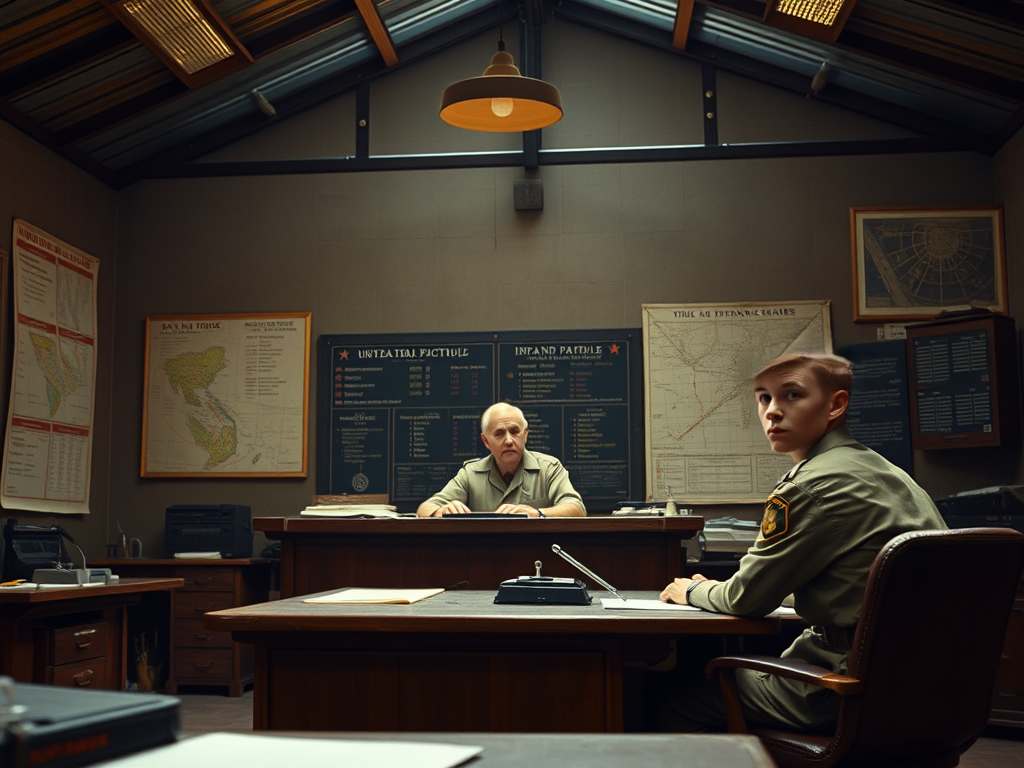
Ulises remembered it all well. Cardenas stormed into the comfortably air-conditioned command center without prior notice. As he trampled through Maguire’s quarters, two military police guards tried to restrain him. However, the captain’s impetuosity was well known, and Maguire authorized entry into his war room. Maps and operational schedules hung on the walls. Piper sat on a desk examining aerial intel photography. He took leave politely, but the Colonel requested that the lieutenant stay.
“With the Captain, one always needs a witness,” Maguire said jokingly. He was a tall, pouty man with a short, graying haircut and large, bulgy eyes. Piper sat at the edge of his desk. He stared intently at Cardenas. It was as if he knew him from ages back.
Ulises, enjoying a smoke by the wood stairs, stayed just far enough to hear the loud conversation. The officers went straight to the point.
“Request permission for a brief session,” Cardenas announced formally. Maguire put on a bored carriage.
“Captain, we’ve already recognized you as a top infantry officer. Keep to it,” repeated Maguire. “I know why you’re here today. Desist this zany expedition into the Vietnamese underworld. Stop making fucking phantom noises over the heads of those poor, ignorant villagers. Let’s just go out and kill the bad guys who want to topple our friends in Saigon.”
“My proposal in Nam is of a different order. I feel I haven’t been given a proper audience to explain it. ”
Maguire stood up slowly and came closer to Cardenas. “Ruddy, you should have joined the Special Forces if you wanted to do spook soldiering. You can’t transfer out from our battalion now. You signed up with us, so keep to your assigned duties, man.”
“A different war requires an incongruous strategy. I requested this unit for a specific reason. We must swiftly neutralize an adversary hiding somewhere in your neighborhood and causing havoc.”
“I know, I know,” Maguire said impatiently. “Listen Ruddy, don’t make the mission here harder than it is for us weary commanders. Stick to hunting the sappers, the infiltrators, and the snipers. Forego those ghosts of the Vietnamese past. We have people above us to respond to in the halls of polity, and your shit doesn’t sound serious.”
“Not to you, Sir, and a few others,” said Cardenas tersely. “I’ve already received too many undercurrents of disrespect from the civilian policymakers in Saigon. Politicians or their hacks, diplomats, wily advisors on expensive contracts… They all lack expertise in running a 20th-century guerrilla war.”
“Ruddy, Ruddy,” Maguire interjected again, his bulging eyes wide open. “Since the beginning of the Republic, American military officers have responded to civilian control. It’s our way. You know all this.”
“With due respect, some of our top advisers in Saigon are misguided. They are impolite to the field officers who fight the war on the ground. Commanders like us have been on the battlefield longer than many of those civilian policymakers in a lifetime. Yet they set the policy.”
Maguire pulled out a cigarette from his jungle fatigue side pocket. Piper came over quickly to light up. “The American geopolitical mission in Indochina has two clear objectives. One, defeat Pan-Asian Communist aspirations. Two, politically bring this country up to date and help it someday become a 20th-century economic power. Our mandate is to conduct day-to-day search and destroy missions to achieve the former. Field victories would make U.S. intervention here more understandable and valid to the world when it sets its eyes on us. Don’t you agree, Lieutenant Piper?”
The lieutenant nodded. Bringing Piper into the fold infuriated Cardenas. Yet, he kept his poise.
“The danger of Vietnam being pawned into Communist subjection should be the least of worries for the politicians back home. The focus should be on why so many impoverished Asian countries become political vassals of China and the Soviet Union. American diplomats should be more sensitive in figuring out this bigger political quandary. How? By gaining deeper knowledge of Asian culture. Understand Vietnam’s, Laos, Cambodia’s dark colonial past before committing our troops to an ambiguous campaign.”
“We all know damn well why the Communists are infesting the minds of Vietnamese youth,” Maguire said with spite. “When the Russians came into Berlin, I was there as a young tank officer. I spent months fighting alongside General Patton’s legions just due west of the Third Reich capital. And like you in Korea, I saw the embattled fields around the Chosin Reservoir stained with our blood. You know Ruddy… General Omar Bradley considered Patton profane. Too independent and not a team player. It was too bad because Old Blood and Guts was one hell of a tactical commander. And he foresaw designs for Communist world domination right in the eye. However, politicians did not wish to deal with Stalin. Now–with all your smarts–you tell me why we are going through this shit all over again in Vietnam?”
Piper nodded again. Taking the cue from his commander, he threw in a statement. “We have the military acumen to deal with the Viet Cong’s aggressive tactics. Down in the tree line or jungle deep. But we also must follow the policy and diplomacy formulated over our heads about Communist domination.”

Cardenas smirched silently. What did Piper know about tactics at the tree line?
“Vietnam is a tough conflict for the Western military psyche,” said Cardenas in a professorial tone. “We constantly must determine which South Vietnamese are truly rebellious. Those who are prone to defect from the nationalism. Then, which South Vietnamese military brass will die to resist Communist ideology, and which secretly despise foreign intervention? We face local political and religious conflict. Add to the mix the internal intrigues of traditional Vietnamese ancestral feuds in every village we go in to protect.”
“Vietnamese society is a mah-jong scrabble for outsiders, alright. But my marching orders are to eliminate insurgency, which I focus on. I don’t care what the world outside thinks we should be doing here.”
“We should. This is not a local conflict. I know that top Viet Cong ideologues are internationalists at heart. In their minds, national and international struggles are bound together in a single effort. They are converting Vietnam into a world stage.”
“Profound thinking,” said Maguire, puffing away irritably at his cigarette. “How does that refer to our military mission in Southeast Asia?
“We must understand that this conflict results from a global revolutionary process of our times, Sir. Propelled by the Bolshevik Revolution, anchored in Lenin’s proposal for worldwide class struggle. Yet, in Vietnam, it takes on a more patriotic tension. It’s more of a battle for the unification of the homeland than a Communist plot. I see this idea in the writings of the Vietnamese literati from French colonial times. This was when there was no Comintern in Moscow or a Mao in China. Even Ho Chi Minh originally embraced reunification over proletarianism. We just didn’t listen to him.”
“They’re all Communist son of bitches to me,” said Maguire. “Everyone down from the generals in Hanoi, their Viet Cong colonels in the south, down to rustic peasant collaborators.”
“I differ,” said Cardenas. “The National Liberation Front knows the rural peasantry does not understand or care for world politics. They play the nationalist card to the full. Agitate in the villages with patriotic fervor, bringing back ancestral hero worship. Historic resistance to foreign intervention. Patriotism, total war, and self-sacrifice. We must understand what we are up to. Otherwise, we’ll be killing peasant soldiers all the way to the 21st century in Vietnam.”
Maguire walked over even closer to Cárdenas, briefly side-staring at Piper. “I hate to suffer fools gladly, Ruddy. And like you, I do have a certain contempt for political directives. Good commanders such as Patton go to war to crush the enemy, not to execute public policy. But we have a mandate.”
“We agree on that, Sir. We simply disagree on how to resolve this conflict for a more definitive outcome. I propose that we thoroughly explore our adversary’s mindset in comparison to our own. We revere our war machines. The Viet Cong revere their ancestral warrior duty. We push our men into combat. The Viet Cong inspire them to go die in battle. Perhaps we should reconsider our approach to fighting. Let’s delve deeper into our adversary’s long-haul aspirations. Militarily support unification in Vietnam, but only through a freely elected government. We’re wasting blood and munitions in a struggle that we may have no leverage to pull.”
Piper cleared his throat. “South Vietnam already went through that, Sir. The North Vietnamese won the 1954 elections. The South disavowed the results. They did not want Communists running their lives.”
“The authoritarian regime of Ngô, Đình Diệm did the wishes of the Vietnamese people properly. They were not consulted. Diem did not want to relinquish power and all its privileges, not fight off Communism,” riposted Cardenas.
Maguire quashed the butt into an ornate Vietnamese clay spittoon sitting on his desk. “Thank you, Lieutenant, for your accurate perspective. Listen, Captain, I trained for combat, not diplomacy. Once again, the US military must defer to instructions from its civilian superiors. It is the tradition–the system. I will not yield to spooks in Saigon with their ethereal tactics for neutralizing the enemy. I refuse to move my combat strategies into dark, impenetrable corners beyond our field commander’s oversight.”
“Come on, Colonel,” retorted Cardenas. “So many political actions occur in Vietnam daily to which we are not privy. But my purpose here is to protest the restrictions of my mission orders. No air support, scant logistics, geography restraints, and a short timetable. I’ve never even heard about many of the regimental acronyms contained that document. ”
“If the politicians and their advisors in Vietnam work that deep in the shadows as you say, to me they don’t exist. That’s my perspective,” interjected Maguire. “So, Captain, those are your orders. Proceed with the mission as authorized and do so in a timely fashion. And Captain… Don’t pull any more Saigon-shadow-strings on me.”
Cardenas fell silent. Maguire stared back and forward from the captain to Piper. “Do I get an answer.”
“I have to check with my other superiors at MAC-V in Saigon, Sir. How much leeway we have for the Thang mission.”
Maguire cringed slightly with annoyance. “Do your spook buddies know how I became a full bird colonel in under five years? I learned to deviate from my preferred plans to execute my commander’s intent. As a good soldier should. Why improvise when the big boss is on a proven strategy?
“It’s not the strategy I am improvising, Sir. It’s the approach.”
“One more time, Captain. Follow my gameplay, and we’ll all be happy.”
“I will comply as much as required by the realities in the field of operation,” Cardenas said dryly. It was the standard reply he learned in dealing with stringent commanders.
“Very well,” Maguire quickly replied. Ah, and please request an appointment next time you visit me. Lieutenant Piper is my new aide de camp. The efficient Vietnamese secretary I had seemed suspect of being a Viet Cong plant, so she’s gone.”
“Yes, Sir.”
Maguire sighed. “You do have a point in one respect. We have much to learn about dealing with the natives.” He then turned to Piper. “Any last comment, Lieutenant?”
Piper stood straight, at attention. “Just a bit of humble philosophy, Sir. While commanding officers wield enormous power in a battle space, they must yield to political superiors. Any other attitude violates the fundamental principle of our military gallantry. We are conducting military actions in Southeast Asia without a formal declaration of war. To a degree, it also subjects us to South Vietnamese political authority.”
Maguire smirked. “The Lieutenant’s right again. We are all biting bullets here in Nam. Another thing. It strikes me that your intel plan implies that the Viet Cong honchos are getting strategic guidance from the afterlife. Isn’t that laughable?”
“They are,” Cardenas said curtly. “By way of cultural tradition. A dynamic we know so little about.”
Maguire shook his head. He sat down at his desk and read his battle logs. Oblivious to and further discussion. Cardenas proceeded to take leave.
Piper raised a hand. “Uh, one more remark, Captain. That idea of redefining our loyalties in the quest for Vietnam unification could offend many South Vietnamese. They have lost so many kin fighting Communist aggression.”
Cardenas thought a bit as if deciding whether to answer. His voice took on as neutral tone as possible.
“I’ve spoken with quite a few of our friends in Saigon and in the provinces. To village chiefs and district officials. Wise, patriotic people who prefer to end the bloodshed and negotiate sharing power with the Hanoi regents under international supervision. National unification is an ultimate quest for these patriotic minds.”
“Leave that to the United Nations. These friends you talk to may be subversive plants. Today, we do war as commissioned,” said Maguire. “Dismissed.”
Cardenas did an about-face, put on his metal helmet before exiting the room, and left. Ulises was already waiting for him with the jeep motor running.”
“I have no plans of visiting these quarters again soon,” he mumbled with a tight lip. “They‘ll have to drag me back here for a new meeting.”
Ulises drove in silence for a while. The late afternoon light began to glimmer amber over the Annamite Sierra to the west. They had only half an hour to reach Hill 54 before dark. Ulises took the short route through downtown Chu Lai. He sensed the captain’s mood festering between aggravation and offense. He had a singular surprise for the officer. But, decided to wait until they reached the Hill 54 bunker for the unveiling. The item lay securely in an acid-free box inside the captain’s leather documents pouch in the back of the jeep.
They arrived just before nightfall. Duquel parked near the command post entrance and immediately started the kerosene generator. The sandbagged dugout lit up with a yellowish light. The single bulb hung from a wooden rafter under the metal plank ceiling. He then entered and placed the pouch atop Cardena’s rustic wood desk.
“The Special Studies section in Saigon sent you a rare item, Sir,” announced Duquel. He pulled out a thin, flat box. “Want to inspect it now?”
Cardenas was taking off his jungle boots while sitting on his cot. He stared at the tightly sealed package. “Of course, unwrap it.”
Ulises opened it carefully and pulled out long strands of black, opaque human hair.
Cardenas stared at it wide-eyed. “Fuck, what is that, an amulet?”
Duquel held the hairpiece higher. “Forensic material, Sir.”
“Is it from the morgue?”
“It comes from the old archive’s depository at Cong Son prison. In 1953, a teenage Viet Minh activist identified as Quyet Thang was held there for a period. He was about to be guillotined for gunning down a French agent in front of the Sûreté Directorate in Saigon. In preparation, they cut the prisoner’s hair. A few days before the execution, he escaped. Local partisan fishermen who infiltrated the island from an old junk helped him.”

Cardenas walked over to Duquel. He took the truss of hair in his hands. He smelled it, squeezed it, and spun it about.”
“Careful, Sir. It’s in delicate condition after all these years in storage.”
“Well, well,” mused Cardenas. “A long-haired warrior. The typical guise of a Vietnamese traditionalist. Probably had it in a twisted strand like his ancestral patriots.”
“What to do with the piece, Sir?”
“Store it carefully. We’ll have one or two of our more clairvoyant troopers examine it. They will check if they receive any psychic scent. Maybe Papio, or our Cuban santero, Castel.”
“May it be a lucky charm for your quest, sir,” added Duquel.
♠
NEXT CHAPTER: CHAPLAIN
 Saigonsong.com - A Vietnam war novel - Rafael Matos