
Each time Ulises Duquel heard the phrase order of battle, he remembered the debates he overheard during Tactical Operations Center briefings, at Da Nang headquarters. Snippets of tense discourse between field officers in the daily feuds sparked by operational control of each other’s reaction units.
Ulises observed that the First Corps Tactical Zone was heavily concentrated with Army, Marine, and South Vietnamese war chiefs. This concentration made the squabbles inevitable. Mostly, clashing views on battle tactics. Debates over the targets and objectives of the day. Allocation of helicopters and who would support whom during the highly mobile incursions into uncharted battle zones. Whose attack plan would outmaneuver or best outflank the North Vietnamese infiltrators in this or that location? No one dared to change the proven, rigid operational procedures.
Battalion Chief Harry Maguire usually led the charge during the late afternoon meetings. These sessions were not even interrupted by a rocket attack on the airfield. Nor a crash-landing aircraft as it returned with damages from a battle scene.
Every day, there were disagreements about what combat unit would deploy the next day or where to go first. Whenever Cardenas was on board, the debates became inquisitorial. Ulises overheard the arguments while he waited in the jeep parked by the louvered walls of the command center. From there, he could sense the animus and the dissent against the captain.

Colonel Maguire’s top staff included three gung-ho Army command sergeants whose names Duquel could not remember. Also, a tight-knit quartet of field commanders steeped in conventional warfare ideals. Marine Colonel Devon Gallagher was one of the staunchest. The Naval Air liaison was Darson ‘Flyboy’ Reickler. As Air Force Combat Flight Director Steven Hendrickson was in charge. Many field officers with the rank of captain swept through the sessions depending on required deployments. The team welcomed the newly arrived Cardenas warmly. Briefed him on each day’s operations. Provided rundowns of expected field duties. When the captain began his psychic war spiels, the mood then electrified.
Heated debates ensued. Outside, Duquel took mental notes for the captain’s logs. He recalled that Infantry Major Steven Blanton often attempted neutrality. However, acrid arguments winged about inside the command center whenever Cardenas turned immovable. They flew like dragonflies over monsoon puddles. The captain had already irritated the bosses since arriving at Da Nang’s headquarters months before. His push into the innards of ancestral Vietnamese culture made the military chiefs uneasy.
Duquel was not privy to all the disputes but knew this much. Cardenas’s tight connections with the key shadow war brass in Saigon protected him from ostracism at brigade headquarters. Colonel Maguire admired the captain’s prior feats as a competent field officer at Pleiku. Lauded his achievements at the Parrot Beak marshlands and jungles near the Cambodian border as an acting company commander with the 25th Infantry. However, he openly blurted out his opposition to unconventional actions within his area of operations. He disliked not being fully briefed on the spook activity of the shadows soldiers.
“You’ve got a good standing, Ruddy,” the Colonel declared. “That’s why I shanghaied you over to my command. But you need to stick to the script up here in the highlands.”
“You do me honor, sir. I bring a new type of intel gathering to our field operations.”
“I want you to know how much I value your 20-year gallop in the ranks of the US Army from a private first class during the assault on Okinawa. And from a top sergeant during Korea’s Yalu River battles, to a field grade officer in Vietnam. Now, this weird entanglement with the shadow people at MAC-V. I don’t get it.”
“I see you studied my record carefully. It’s been a wild ride career.”
“It may all hang in peril, son. Don’t jeopardize your shiny armor role in the infantry for some wild spooks in Saigon.”
Already with a leather hide in military echelon politics, Cardenas diplomatically side-stepped the colonel’s warnings. “All my battlefield experience is at Battalion disposal, sir.”
Maguire scrubbed his cheek with a tense hand, then swiped it from forehead to jutting jaw. What’s with this ghost-detecting operation? Why are you recruiting soldiers with freak abilities? Hearing, smelling, or seeing spirits?”
“I am setting up a small Psychological War Detachment at the Chu Lai camp. It functions as a holding unit for soldiers with special capabilities. In sysops nomenclature, it’s all about the ability of some soldiers with extrasensory perception. No sense in having them killed in an ambush. We want to train them for remote viewing.”
“Spying on dead people. Are those real military abilities?” inquired Blanton. “In my infantry world, combat survival is the top special skill. What is this new competence you now bring to the table?”
“Clairvoyance, Clairaudience, and Clairalience,” Cardenas replied with impatience. He had sent each top field commander classified reports. These reports explained ESP dynamics. They detailed how extraordinary sentience could be used for military intel against a furtive adversary in Vietnam. It was still an experimental field of research, granted, but nothing new.
“To what gain?”’ asked Galagher, a perplexed demeanor all over his face.
“ESP can help us in detecting psychic evidence, non-physical clues that lead us to highly placed Viet Cong partisans immersed in animist cults in recruitment propaganda. I am getting technical support for this from the Operations Research Office at Fort Riley. It’s all in my recent memorandum to Battalion Command.
“Ah, Fort Riley. The home of the Big Red One. My infantry Alma Mater,” said Major Gil Hanson, another frequent advisor at the brigade-level team.
Cardenas nodded. “It gets even more interesting. Back in Saigon, I’ve been hooked up with Lieutenant Jax Aznerz, a junior naval officer with solid studies in the new field of artificial intelligence and computing mechanics. He’s a machine language programmer trained at Carnegie Mellon< Works with mysterious things called compilers, assembly language, Fortan, Cobol… He also happens to be a good Stallion helicopter pilot. He is prepping an analytical engine for us to collect data on enemy terrorist attacks all over Vietnam. The analysis will predict patterns of target choosing, attack dates, and types of explosives.”
Naval commander Reickler, who usually kept mum and took detailed notes, finally weighed in. “I hold Aznerz in high esteem. He plucked me out of the South China Sea last year when I had to ditch my Skyhawk after an air intelligence run over Haiphong. Didn’t know he was into thinking machines.”

“As a naval cadet he did workshops with Vice Admiral and renowned computer scientist Grace Brewster Hopper at George Washington University during the early 60s. His Vietnam computing work is covert for now,” Cardenas pointed out. “
“The US Navy does maneuver its assets well, even in the battlefields of high mathematics,” said Reickler with pride.
“We also have with us a Psyops Warrant Officer, Armand Amador,” Cardenas included. “He flies a Cayuse to remote areas at the Laos border by using the guise of locating weather balloons. During the run he drops leaflets printed with arcane messages and photos of dead Viet Cong operatives, messaging North Vietnamese infiltrators to go back home to their families while still with skin. As a result, we have vetted some desertions.”
“Warlock warriors. Wizard soldiers. Brainy machines. I knew this war would be bizarre,” a Marine top sergeant commented. “Tell us more, Captain.”
“All this information is highly classified,” recommended Cardenas. I am just identifying key personnel working with me on the Thang mission.”
“See!” screeched Maguire. “This is what pisses me off about spooks in the midst. Lower echelon officers know more about what’s happening in my operational area than I do.”
Galagher jiggled his hands. “No fucking shit! It worries me that this Tango Platoon of yours is meant to be an autonomous unit somewhere within the dark recesses of the Navy or Army combat operations. Detached from any regular command staff.”
“It’s not about inter-service rivalry, Sir,” defended Cardenas. “Our main mission is to delve into the history of past insurgencies in Indochina to help educate new intelligence officers on what to expect when serving in a Southeast Asian war zone. And how to set up SOPs tactics to destabilize the Viet Cong indoctrination networks.”
“I see too much strategic uncertainty. Little synchronization and even less field-level supervision. All is too murky for us commanders to grasp,” said Blanton.
“I hear you have your own black ops budget?” Maguire inquired suspiciously.
“It’s for paying informants and for civic action. A few weeks ago, we donated baseball gloves and set up a soccer field at Binh Tinh village in Tam Ky. The VC later confiscated all the sports equipment that our pacification team distributed. The stuff turned up later in the Da Nang black market alleys. We marked the equipment intentionally to track its movements. We’re doing the intel on that to…”
“I see all this as a long-haul strategy,” interrupted Galagher. “I prefer to send an entire division across the 38th parallel tomorrow, keep going to Hanoi, and get this over with by Christmas.”
“The way I understand it,” Hendrikson said. “The Johnson administration is limiting direct actions to North Vietnam to avoid pissing off the Chinese. Impede any full Sino involvement, as occurred in Korea. White House advisers maintain Vietnam is not worth a full-scale conflict with China, or by proxy, with the Soviet Union.”
“That puts the burden on us field commanders,” shot back Maguire. “Captain, I hope this makes you see how critical our combat operations are… Sweeps against the Victor Charlie hideouts, destroy materials and equipment, body count. In my book, there’s no time for abstract warfare. Interesting as it all sounds.”
“I call we put your shadow research on hold,” said Blanton. “I have ten slicks flying out tomorrow to A Shau Valley for a big sweep operation. Your three idle company of riflemen at Hill 54 could support our First Air Cav troopers.”
“We’re cavalry, Ruddy,” said Hanson. “Not spooky folks of the spy craft business. We’re not in Nam to put on hexes on the enemy. Lead plugs are more effective.”
“Our marching orders are to clean the jungle?” said Colonel Maguire. “In the business of waging war. We test what works in infantry and what does not.”
“Every commander,” said Cardenas, “wants to outsmart the Viet Cong on the battlefield. But in this conflict, it’s the guerrilla who decides where to fight. Why not try to determine how they design their tactics?”
“We’ll probably find out by the year 2000,” Maguire said, shaking his head. “I’ll be open with you, Ruddy. We don’t like you overriding the chain of command in our territory by using shady contacts in the murky world of CIA spooks and Special Studies Groups in Saigon… Or whatever spy rubric they give it.”
‘’Special Operations Group, Sir.”
“I have reserves about people who fight in deep shadows. I am a soldier bred in the battlefields of the Reim with Patton and at the Yalu River with Macarthur. Just my way of being,” said Maguire with a shrug. He stretched out in his lounge chair and put on a demeanor of mental exhaustion. “I’ve had too many bad days this week. I have more enemy riding my ass here at First Corps than any commander below my zone.”
“Let me just state this premise…” Cardenas requested, but Maguire put up a hand to the air and interrupted him.
“I’ve been up since four in the morning. Following up on walking artillery tactics we devised for the new Au Shau Valley firebases. So, are we on the same page, Ruddy?”
Cardenas tensed. “I know I am out of favor, yet will follow the script, Colonel,” he said firmly. “I will comply with combat arms operations assigned to me. But, parallel to my field assignments, I will continue my intel research about the Cong underground.”
The colonel exhaled sonorously. “The Secretary of Defense wants us to end our mission in Vietnam quickly. I know we won’t win by killing one enemy soldier at a time. I foresee we will need to scale up our interventions in the next few months. If that happens, it will be over soon. With more troops and assets.”
“I beg to differ,” insisted Cardenas. “Our mode of operation in Vietnam is self-inflicting injury to our Army with strategic wounds. We send infantrymen to the field to fight an enemy about whom we know little. This is confusing since many innocents get killed along the way and traumatize our men,” the Captain insisted. “Much of the Vietnamese population despises us already.”
“You sound like a fucking dove diplomat sometimes, Ruddy. What’s really on your mind?” demanded Maguire.
“We are fighting two wars as one, Colonel. At this moment, there is an insurrection and almost a regular conflict. Perhaps it will become a conventional war when North Vietnam sends in more regular troops south. For now, we must study the National Liberation Front more intently and explain these findings to our soldiers. They must understand why we are hunting an enemy that, as of today, they cannot distinguish from regular combatants from the North,” said Cardenas.
“Our mode of operation is to waste anyone in the field with a rifle and intent to kill us. That is all our combatant needs to know,” Maguire retorted.
Cardenas grimaced. Major Hanson pointed to a captured NFL flag hanging from a nail as a battalion war trophy.
“What you say is a VC ruse. Make us believe it’s an asymmetrical conflict. They dupe us into engaging in light skirmishes and a waiting NVA contingent shoots us in the back. We have no time to waste on ideological parodies. We are men-at-arms, not theorists.”
“Then we will be playing their game for the next ten years, as we keep losing adepts in the war front and sympathy on the world stage,” predicted Cardenas. “Many nationalists in South Vietnam are already National Front agents, infiltrated into every layer of Vietnamese society. Even into our military infrastructure. We need to sort them out. Them annihilate. And mission done.”
“We went through this with the Japanese Secret Services and their inside agents all over the Pacific. In Korea we had to match wits with the infamous Reconnaissance General Bureau,” commented Gallagher. “It will take 25 years to sort out the other war… The political, ideological, and social mess in Vietnam. I say we do search and destroy and be done with it. Innocents die in all wars. As in Europe, Japan and in Korea.”
“I know. I was there as a foot soldier and as a field sergeant,” Cardenas added, “I see parallels. We began in Korea as a police action that gradually evolved into a conventional conflict. But we knew the enemy well. Can you imagine what can happen in Nam if we don’t define our adversary?”
Maguire puffed frantically on a cigarette. “Tell you what, men? My Command Center is not the War College back in Panama. We have soldiers dying out there in the jungles as we try to divine who the enemy is. Let’s return to our quarters, fight this war, and let the historians sort it out later.”
Cardenas grunted, grabbed his helmet, and walked out of the meeting smartly.
“Good luck with your little covert intelligence unit, Captain,” Maguire shouted as his field officer left. “But also kill a few gooks for us this week.“
“With all due respect, sirs, I regret you regard my mission as lacking standing,” said Cardenas as he shuffled back into the room. “But there are already formal commitments I’ve made with our South Vietnamese intelligence counterparts.”
“I will report this discussion to MAC-V in Saigon and get a final determination. Meanwhile, follow the order of battle. That should be all for today. Thank you, gentlemen,” proclaimed Maguire.
In the words of Colonel Maguire, images of body count terrorized enemy fighters more readily. Dead enemy corpses were more persuasive than leaflets with sketches of spirit warriors.
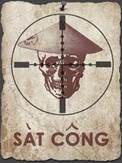
Exactly two weeks after the last heated debate, Maguire had Lieutenant Piper redact the new Quyet Thang mission orders. This gesture and the many restrictions imposed on him stirred more bad blood. The captain expected at least a formal closed doors, high-level conclave to hear him out. He wanted to explain even more classified details to the commanders. He also wanted to present a final rationale for the plan. Having a lower echelon officer –a FNG— to write up and deliver his marching orders tasted like a smartass offense to the captain.
For Cardenas, it became a time to bite bullets. Top brass resistance at Da Nang to his designs seemed to have no finality. Obliged but disgruntled, his new chiefs totally disagreed with his proposals. In their minds, the traditionalist ideologues at Viet Cong headquarters –the Quyet Thangs– existed as legend. In any case, Vietnamese subversives should be given hell, not clairvoyance.
A Fucking New Guy was a cherry warrior to seasoned grunts. They had little or no notion of real field operations beyond the camp gate. Piper had trained as an ordnance officer. He fully agreed with field commanders at Da Nang. All wanted to keep tactics as conventional as feasible. Upon receiving the orders, Cardenas ordered Ulises Duquel to drive him to headquarters.
They rode to the base in a tense silence. Cardenas was quietly fuming in his innards. Duquel could sense the controlled ire vibrating in the officer’s psyche. He feared that by mid afternoon, the captain might be sitting in a stockade.
♠
 Saigonsong.com - A Vietnam war novel - Rafael Matos