
In his agonizing moments at Bao Cat, Ulises Duquel reviewed his short life as a foot soldier in Vietnam. A venture filled with too many jolts. A torturous love affair without a finished song. An unseeable war baby. Field officers in dispute over how best and cruelly to waste away an intractable enemy. Blasts of supernatural mysticism in the fray of battle. Musical notes floating above the war ground in synchrony with political intrigue. All to no end, except deliverance from confusion at the point of a sniper’s bullet.
“Two men down. Intense ambush. My lead elements are pinned down by sniper fire. Unable to approach designated objective. Requesting permission for tactical retreat,” yelped Lieutenant Piper on the platoon radio.
“Negative. Conquistador never turns back!”
Piper seemed perplexed at this reply, but Duquel silently deciphered the coded message. Cardenas was instructing Piper to advance. The lieutenant was not fully trained in infantry maneuvers. He was even less familiar with Cardenas’s covert operational tactics. However, after a few minutes, he figured it was a ciphered code and acquiesced. A new order came instantly.
“Put crossbows in place.”
Ulises barely heard. A low-voiced Piper gave a new order to point man Espino. He commanded him to position sharpshooters along the mesa’s outer rocky niches. To activate the Sniper Killer Team. It was one of Cardenas’ secret offensive weapons in the field. The captain learned these tactics while serving as a field officer with the 25th Infantry in the Pleiku area. This was two years before Bao Cat. From there, he recruited his three best marksmen, all veteran noncoms. First Sergeant Tabal had spotter duty. Buck Sarge Espino carried a Remington scope rifle. Spaniard Ignacio Azulia, who hailed from a sport-hunting family in the Basque region, carried a sniping M14.

Further orders came on the radio from the Cayuse overhead. “Conquistador wants crossbows on the east ridge flanking the village approach. I detect at least one enemy on branches of the tallest Banyan tree from your west flank.”
Thibodeaux relayed the new instructions. Quickly, Espino pulled out his binoculars and scrutinized the canopy. Last June, Cardenas had given Tango Troop an intensive course on Vietnamese tree flora. Piper stalled. The lieutenant was purposely kept in the dark, by Cardenas, on many of the platoon’s tactics. He also never fully grasped all the codes used by the captain in the field. He also never fully grasped all the codes used by the captain in the field. But Ulises and the loyal sarge Tabal knew better.
Their officer was a fanatical student of the Spanish conquest of Mexico. His master’s thesis at the U.S. Army War College focused on the cunning encirclement strategy of Hernando Cortés. Studied how Cortés gathered and applied political intelligence to conquer the great Aztec Empire of his time. Even adorned himself in finery, feathers, and gold like an ancestral Mayan lord.
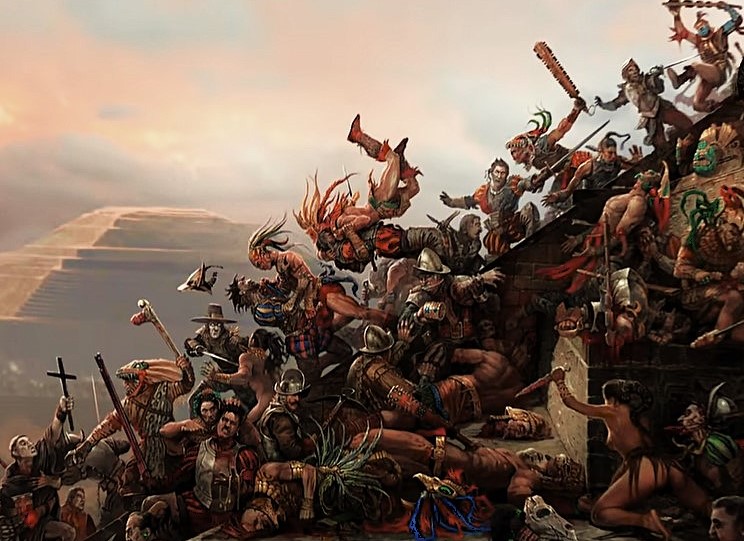
Cardenas was a Mexican American who hailed from the Quintana Roo region of the Yucatan Peninsula. He considered himself an indirect descendant of the Spanish Conquistador. The imaginative officer had read deeply into the Conquest saga and added mystical twista to his reveries at Tango Troop. He took the time to ascribe historical lineages of the Conquest to his soldiers in Nam. Duquel echoed the toils of Bernal Díaz. principal scribe to Cortés. His field sidekick Tabal was to be as Cortés’ most loyal lieutenant, Pedro de Alvarado. Cardenas consigned those two historical characters as instrumental in bringing down the Aztec Empire.
Interpreter Boi Nguyen became Gerónimo de Aguilar, a Spaniard marooned in Maya lands during an earlier expedition. Cortés’ men rescued Aguilar in 1518 following instinctual clues to his whereabouts. Aguilar’s ability to speak Maya dialects helped Cortés deal with the Oriental Sierra Madre natives from Veracruz to Texcoco, as did Boi in the Annamite Cordillera villages.
It later turned out that in the captain’s historical whimsies, Lieutenant Kikei was a descendant of Maya girl Malinche. Cortés secretly considered Malinche’s pedigree too traitorous to trust. Winsomely, combat medic Rawlings was the mulatto, Alonso de Grado. In the historic annals of Mexico, Cortés considered Grado a chief agitator. He imprisoned him briefly when the Spanish hidalgo refused to march against aone of Montezuma’s tribes.
Duquel discovered constant historical reveries in the personal diary Cardenas kept under lock in his leather case. Chaplain Santangelo was paired to missionary Juan Diaz, the priest that delivered mass on Easter in Ulua with Mexica indians. Radioman Thibodeaux was akin to Alonso Yañez, the conquistador who built an altar and cross in Cozumel after knocking down idols of Aztec shamans. Piper was to be Alonso Penate, one of four traitors who tried to steal a ship to return to Spain and denounce Cortés.
Duquel listened to all the historical yarns with honest curiosity as if the captain were narrating a retro Cinemascope movie about the fall of the Aztez Nation. In his cast of characters Cuban scout Castel was akin to Andres de Tapia, a foot soldier with pyschic gifts who was able to locate captive Aguilar in the dense Mayan jungle. Grenadier Jaramillo was Arbenga, a Levantine armorer who cleaned the guns and checked ammo before each battle with the Aztecs. Next came the sharpshooter Azulia who Cardenas affixed to be Ignacio Heredia, Cortés’ most appreciated Basque musketeer.
Comically, Cardenas addressed his soldiers with the proxy names when on the battlefield. And in his mimical game of historical genealogy, Cardenas convinced Moises ‘Papio’ Pinay of a peculiar idea. He believed Pinay directly descended from the first free Negro in America to join the Conquistadores. He was a personage somewhat like Negro Juan, a former slave and weapons courier for the Spaniards who embarked with Cortés from Havana, Cuba to Mexico’s Veracruz region in 1519. Even Riverito, the company cook on Hill 54, was likened by Cardenas to Hulano Guzman, the appointed butler in Havana and chamberlain to Cortés in Mexico.

Such vagaries spilled into Duquel’s mind as bitter minutes rushed by during his agony at Bao Cat. The ambush got thicker as cracks of .30 caliber machine fired out of the deep west end of the village. He glinted towards that direction. Were guerrilla reinforcements coming into the fray from the Laotian side?
Using codes and names in Spanish for field communication was not all historical gameplay. Cardenas was aware that specially trained Viet Cong spy elements knew how to pick up clear English military jargon. Documents captured in the tunnels of Cu Chi the previous year produced guerrilla radio manuals in English. The booklets contained much of the American military slang used in Vietnam. They also depicted the playful radio call signs used by commanders, pilots, and field troops. Included were artillery call signs by forward observers and platoon leaders. In response, Cardenas created his own, homespun set of encrypted codes in Spanish to confound the enemy field radio snoopers.
Thin, high clouds accumulated over Bao Cat, signaling an early afternoon shower. Meanwhile, Jaramillo kept lobbing the village plaza with grenade volleys from his position behind a cliff boulder. Duquel timidly ventilated. His lungs hurt as he saw no sign yet of medic Josiah Rawlings. His sense of smell slowly vanished. Not even the cordite smell of grenade discharges reached his nostrils. Piper screamed out orders. Papio sporadically blasted his M-60 in the direction of the village gate. Duquel still barely heard the shouts. Those sounds seemed diffused and distant.
The landscape around him acquired hues and echoes he had never seen or heard. His breathing became heavier. Inhaling became difficult, as he wondered if the Viet Cong sniper was watching his life fade away, thinning out like the high clouds. His blood draining like water, drop by blood drop. Who was his slayer? Could his wound be the deadly handiwork of Quyet Thang himself?
An even stranger sensation took over Ulises. He felt Quyet Thang’s presence near him. In a familiar, almost kindred manner. It seemed so unusual. Perhaps because he had studied this personage so intensely. Maybe it was the delusions of a brain wracked with low blood oxygen.
A new sequence of musings paraded backward through his weary mind. Opaque and lacking smell or sound. In a walk back to Cardenas’s many briefings about the enigmatic revolutionary, Duquel realized he was now also sickly obsessed with the enigmatic guerrilla warrior. Anecdotes, colloquial legend, and folk tales, gleaned from interrogated prisoners at Pleiku, and other informants placed Thang as the head of urban guerrilla units tracking South Vietnamese government officials and collaborators. Other captured documents displayed fractions of Thang’s main insurgency career at its peak, highlighting his mastery of disguise.
At 32 years old, Thang was heavily involved in intense indoctrination, interrogation, and assassination of anti-Viet Cong collaborators in rural villages. He also participated in propaganda activities within urban cultural circles in Vietnam’s central coastal cities. His capabilities developed from experience as a former Viet Minh street fighter and saboteur. He became a fanatical political agitator. Duquel and Boi also had discovered that to spice up his harangues to the Liberation Front recruits, the expert indoctrinator deftly delved into and exploited Vietnamese traditions, history, and mysticism.
Ulises Duquel’s anthropological instincts made him surmise that there was not one, but many versions of the same Quyet Thang. Theoretically, this explained his ubiquity at many rebel fronts. For Cardenas, it was one and the same adversary. A complicated revolutionary persona who skillfully knew how to move among different rebel scenarios and disguise his tracks. So many of Thang’s many peculiarities fascinated the captain. One facet, the cadre’s spirited nationalism, reminded the captain of Nazi Germany’s Teutonic harangues.
Duquel recalled Cardenas’s conclusion. “Nazism was a blasphemy to humanity. Yet, it understood how human conflict requires a psychic vortex to gain deep control of the collective mind.” During one of their long conversations about revolutionary movements, Cardenas added: “Hernando Cortés and his captains knew that four centuries before, psychic force, played with mystic beliefs ha been used to crush the Aztec imperial soul.”
He spoke about how master political manipulators impose social dystopia. In a disordered society, they move quickly to gain control of the people’s fickle will. Legend had it that Thang personally executed political and military adversaries in a push to gain psychic control over opponents. Cardenas suspected that the guerrilla chief had ordered a sniper to kill Uncle Bernard Cardenas. This happened the year before Cardenas’s transfer to Da Nang. Bernard was a 25th Infantry badass top sergeant about to complete his last tour in Nam. He was ready to retire after 35 years of military duty. Had spent three years as a field advisor to South Vietnamese commando units. Surely a hot target for the Viet Cong avengers. Bernard had been the captain’s lifelong family mentor, jump-starting and guiding his military career. His demise hurt Cardenas to the core.
Then came one more vile execution. Cardenas’s close special ops collaborator, Lieutenant Colonel Stanley Cavazo, at the Laotian Plain of Jars. It clearly showed Thang’s death-dealing hand. Thang’s presence was ubiquitous from Pleiku to the Laotian side. This clearly indicated his skillful movement throughout Vietnamese rural scenarios. He recently had moved seamlessly to urban centers in Central Vietnam.
Duquel wrote constant notes in Cardenas’s logs: Little else is known about Thang. All his penal records had mysteriously disappeared from French Sûreté archives in Saigon. This happened during the Diem regime. Enigmatically, Vietnamese security police handlers who intervened Thang had all demised soon after. Interrogated prisoners at the Iron Triangle and Saigon give different versions of Quyet Thang. It is not difficult to believe that Quyet Thang is a pure revolution legend.
For Cardenas, finding Thang became the greatest challenge of his military career. No one knew this obsessive intent better than Ulises himself. As the captain’s scribe, he had to record every single diligence of the quest. But he was unable to shake a secretive sentiment in his mind. Duquel felt the captain’s relentless hunt was primarily motivated by rancor and a secret desire to avenge the killing of his close comrades in arms.
The Viet Cong cadre’s escapist abilities also fueled the pursuit because Thang never left any clues at his battle stations. He would simply disappear. Many of Cardenas’s detractors believed he was chasing a specter of Vietnamese lore. The captain insisted his prey was real, lethal, and psychopathic, and a hindrance to quick, decisive US military victory in Vietnam. This thesis earned Cardenas some support. He gained backing from other imaginative minds in the intelligence corps in Saigon. Warlike spooks who operated in the shadowy corridors of geopolitical power.
If as real as some testimonies decreed, Ulises considered Quyet Thang an inevitable historic actor of his epoch. A hardened, and clever, rebel commander who received no mercy from his French colonial tormentors, nor from Diem’s tyrannical warlord bullies. Thus, he showed no mercy to any adversary of his patriotic ideals.
As an added layer of intrigue, Duquel suspected that some of Cardenas’s doubters masked spite. He understood that capturing a highly evasive, charismatic, legendary Viet Cong chief would significantly boost Cardenas’s military career. It would establish him as the Vietnam campaign’s great guerrilla hunter. Even generals would consult him. However, some in Saigon’s military hierarchy saw the captain’s ego as gone berserk. As a sort of maniac and as possessed as Cardenas’s favorite historical character, Hernando Cortés.
Nonetheless, having placed boots at Bao Cat, Cardenas expected to find at last, a trail leading to Quyet Thang. Weeks before, he poured over hundreds of air reconnaissance images. He examined visual sightings of the deftly camouflaged array of radio antennae behind the hamlet. They barely stuck out visibly from the foliage. The reinforced bunkers behind the sturdy pigpens also denoted an underground tactical control center. A structure only a high-echelon Viet Cong cadre would command. He carefully marked waypoints and coordinates on his campaign map.
While waiting for medical aid and for the crossbow squads to move into place and turn the tide of the battle, Ulises recapitulated. Cardenas should not have kept his foot soldiers in the dark. He played cards too close to his chest. The man was paranoid about snitches, snatchers, and slackers. He even considered his Lieutenant Jeremiah Piper a humiliating nuisance. A pestering gadfly who would not go away. Always prying.
The mission’s bizarre tensions thus split up Duquel’s loyalties. He considered the greenhorn Louie quite intelligent and squared away, with moral courage. Overall, he appreciated the captain’s military acumen, battlefield experience, and his scholarship as well. Cardenas ensured his non-commissioned cadres were well-trained, properly armed, and aware of every battlefield situation. Nevertheless, Ulises needed to trust and be trustworthy to both top officers. Not one over the other.
He felt distracted trying to understand why the astute, battlefield-seasoned Cardenas agonized so much trying to figure out why a novice officer–an open critic of the Quyet Thang mission–had been imposed upon him. No one in the company knew, except Ulises Duquel.
Lovers’ heads lying on the same pillow warm up to each other without limitations. Kikei Santos, his talkative Mortuary Services paramour, accidentally revealed the Piper’s ploy. It happened as they lay romantically cuddled in an underground love nest at the coastal edge of Da Nang Airbase.
♠
 Saigonsong.com - A Vietnam war novel - Rafael Matos