The skirmish took on an uneasy rhythm: irregular and furious weapon discharges and then stillness. Tango Troop soon realized that the guerrillas in this village were experts in setting up invisible ambushes. Appearing and disappearing like haunting ghouls.
By mid-afternoon, a strained lull settled over the clash. An anxious vigilance dominated the scene as weapons on both sides went silent. On Piper’s order, the platoon halted its main advance towards the village center. Everyone tried to gauge the opponent’s killing competency. Ulises no longer heard the wop-wop of the Cayuse helicopter overhead.
Seconds, minutes, hours… Ulises lost track of time lapses or the measure of moments. Only place and memory mattered. In his thoughts, the fighting lull seemed eternal. He remembered Doc Rawlings had once told him of the imaginings of dying soldiers on the battlefield. To the medic, a dying brain was like a cinema verité flick. Splashes of both joyous and macabre images. Sad and blissful sounds. All merged into a single frame.
It felt true. When the skirmish fell silent, Ulises’s feverish mind began to recall the muffled voice of lover Kikei Santos. Her words danced both near and distant. Images of their affair paraded equally with hard realism and a misty evanescence. Dreamy scenarios of far-off places. Conversations about surviving war. Forging a life together. Becoming human again. She proposed they set up a home in Pupukea Valley in Oahu. He lobbied for Old San Juan.

A purplish plumeria flower appeared in his mind’s view. As background, he heard a forlorn tango from another time and place. As if emerging from the vintage Victrola in the living room of his childhood home. It was always on, always spinning sad tunes for his melancholic mother. Next, as the melody faded away, Kikei’s voice formed a terrible message. One of her frequent omens about death and transfiguration whenever he offered to marry her.
“An old Samoan shaman once told me that death is a know-it-all, Ulises. When the soul wants to take over, the physical body is no longer needed. The spirit energy reworks the carcass to a discarded pile of tissue and cartilage. In Nam, keeping body and soul together is a toss-up. Let’s survive first. Then we can dream of forming a home.”
Her words surprised him. She was not a lyrical persona, much less a deep mystical thinker. Rather, a no-nonsense battlefield forensics technician. In Nam, her gruesome work filled her every moment. She spent many nights with corpses, mutilated limbs, viscera, and the odor of embalming fluids. Mortality permeated her every perspective of life. Ulises often felt her conversations seemed like dictations from a class in gross anatomy. Unsettling and abrasive. In those early days of their illicit liaison, she seemed fixated on the unliving. Somewhat like the vultures on the nearby tree limbs.
As he lay fatally wounded in Bao Cat, her discarnation rumblings suddenly took on a fateful significance. Just as she had described, his brain started to shift his reality away from physical dimensions. It began reworking the body toward a more unearthly horizon. He gently sobbed and then repressed his gloom. He refused to go without a chorus. He wanted to invoke a joyful song. Like those the monk Jampa Kochi invited him to listen at the monastic nunnery by Marble Mountain. It all seemed so long ago.
Another sob, this time for endearing sentiments. A hymn to good memories. He recalled plucking the plumeria from Jampa Kochi’s little rock garden atop Marble Mountain. He delicately carried it back to the morgue and stuck it in Kikei’s formaldehyde-perfumed hair. An instant of tenderness and powerful respite from the severity of death and mutilation that surrounded their lives. In that intimate moment, they felt together, merged, steeped in happiness, and so in love.
And then, as if staring through an inverted spyglass, his recall jumped back to the first days as a soldier levied to the combat zone. After two weeks in country, he anxiously awaited assignment orders for his year-long tour in Vietnam. As a newcomer to Da Nang, a single-minded uncertainty dominated his will. Not knowing what came next petrified him. Only half a year before, he was walking among the brick, stone, and granite-trimmed halls of academe at College Park. At the Syracuse campus, Ulises is deeply and with certitude engaged in anthropological research. Worked on proposals for a thesis on Afro-Caribbean musical formulations. Studies on musical manifestations amid the post-arrival outcome of the Europeans. Theorems and hypotheses with bombastic titles as required by the accretion of new knowledge around a scholarly premise.
But now, 10,000 miles away, he strolled along a shoreline road near an old fishing wharf by downtown Da Nang. Despising the regimentation of military order, he lost himself in thoughts of loneliness and survival. He dreaded ending up in an infantry unit. Feared hunting hell-bent Viet Cong guerrillas among prickly jungle undergrowth. The odor of humus soil and the menacing, massive forestry of the central highlands gave him dislocation anxiety. His mind scoured for a viable political tactic to escape combat. He was not a pacifist but lacked the stomach for search, destroy, and kill military operations.
Then the memory of his chance encounter with the cheerful monk came into focus, lightening his somber mood. If death were a know-it-all, then nostalgia was joy-it-all. He happily recalled the day when Jampa wised him up by the shore lane mango tree. It brought back the grit and fortitude that the friendship with the monk provided to his soldiering misery. In the presence of Jampa, Duquel’s angst instead smelled of sandalwood incense and pranced to chants of ancient songs. Their colloquies gave him clues to grip the entanglements and contortions of fate and circumstance. The closed-ended labyrinths of life at war.

At Da Nang, Ulises hoped to escape the dreary routines of garrison duty. Being in-station without assignment meant long midnight shifts at the guard towers. Supernumerary soldiers staffed claymores by the wire, did long shifts burning human waste with discarded aviation jet fuel. He thus performed hiding acrobatics to escape the base support routine. Ulises only wanted to breathe a few last, small, free-spirited adventures. He usually hitched a ride on a courier Jeep at a base gate, offering to ride shotgun.
While the driver completed his errands, Ulises walked along the shoreline. Absorbed in thoughts about the potential perils of his new situation. At the Deployment Detachment, he heard stories. Tales about how Replacement officers would assign clerks, medics, cooks, mechanics, and supply specialists to infantry combat slots. PhD candidates like him hastily filled positions in jungle scouting units, as point guards or as radiomen. Infantry detachments suffered as many as a dozen grunt casualties every day.
He preferred to hitchhike from a base gate near town and by the old French colonial railway. Colonial Road One traversed a few train stations and was lively on the civilian side. Since imperial days, the older Vietnamese referred to it as the Route of the Mandarins. Duquel saw street vendors peddling incense sticks along the road for the upcoming lunar month. A kaleidoscope of aromas saturated the air. In front of the small home shops, squatting women wearing conical hats vigorously split wood for cooking.
He rode with a courier on a mail run to Freedom Hill on the north edge of town. Duquel noticed a funerary wreath and coffin shop. Varnished caskets were on the sidewalk. Quite a few were for small children. Out in the distance, mountain roads still had bands of foggy haze hanging from cliffs. Vietnam was an ancient land of culture and tradition. Remnants everywhere of imperial palaces, citadels, temples, ramparts, and the stone towers of the Cham civilization.
He asked the driver to drop him off at the old market square by the seashore, and he walked south along the old wharfs. He lingered by a spot where fishermen repaired nets or unloaded their daily catch of sardines and mackerel baskets from their boats. Intense sunlight soon deluged the day. Seasonal winds blew towards land, ushering the pungent smell of coastal seawater splashing against rocks.
Ulises observed a ragged-looking monk. The holy man was tending to a short line of sick people under a shady mango tree, the trunk of which must have been a century old. The lama listened attentively to each patient, prescribing unguents, sharing smiles, and dispensing encouragement. Everyone seemed to go away content.
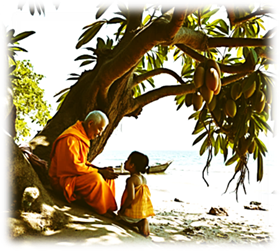
Ulises watched as a village carpenter came on cue with a rusty nail stuck into the ball of his hand. The monk deftly pulled out the spike and packed the open wound with fir tree balsam and a strip of Asian Birch bark as a bandage. Folkloric, street-side medicine. Next in line, an old toothless woman displayed sores up and down her arms and legs. Ulises quickly identified the malady as shingles. The monk examined her carefully and, out of his bag, prepared a salve of seawater and yarrow leaves. After a short dialogue, he vigorously massaged her extremities, hummed a song gently, and sent the matron on her way.
As the monk packed his small bag for the day, a teenage girl ran over and showed him a festering cut on her leg. The monk extracted an ointment from a small vial and treated her lovingly with a short prayer as the main antidote. Then, the holy man glanced at Ulises and summoned him with his hand.
“Hello, my soldier friend. A chipper day to you.”
Ulises approached cautiously. He visually examined the monk’s robes for a stethoscope or armament. “Are you the local physician,” he queried, trying hard not to sound like an official inspector.
“I am the tribal medicine man,” he laughed sonorously and quickly composed himself. Just a little joke, guvnor. My name is Jampa Kochi.”
Ulises bowed politely. “I admire your British accent.”
The monk smiled. Duquel had visited one of Oxford’s Indo-European studies campuses for a short spell as an exchange student a year ago. He recognized the Queen’s English accent, shaped on campus by years of tradition and academia. “I also noticed your head is not shaved. You’re the only monk in Vietnam I see with hair. How did one of Her Majesty’s subjects find himself in Da Nang city’s backstreets? Dispensing health services to Vietnamese peasants?”
“I will tell you that story some other day. My circumstance compels me to move on today, The present time only moves forward. Though not a physician, I am the only medical counsel these impoverished fishermen have within a hundred miles. Folk medicine is what I dispense.”
“I do see gratitude in their faces, holy man” said Ulises.
Jampa walked closer to Ulises. “And what is your name, lad?”
Ulises Duquel, US Army. Are you from a Buddhist monastery in Da Nang?
“Quite not. I am from a Buddhist monastery at Marble Mountain. That is another tale I owe you since today. The monks there make a living gathering firewood and hardwoods for house facades, harvesting timber, selling handicraft wood. But recently, Americans arrived on the coastal plains and razed the trees for military bases. Now, the monks live off small tithes and payment for humble services. I do mine with the sick and infirm among this fishing populace.”
“On payday, I will donate some piasters,” promised Ulises. “If I’m not out in the boonies.”
“I value your generosity. Intentions are redeeming. Monks need to put some copper in the bag. Holy man eat, too,” Jampa said, smiling. He then became grave. “I sense in you a dread.”
Ulises felt secretly surprised. He evaded the assumption. “That liquid you rubbed on the girl’s leg. It had a golden glow. Was it honey?”
“It is liquid amber. Good for small tumors. Alleviates dysentery, rheumatism, and arrhythmia. Your dread is overpowering you, lad.”
Ulises Duquel saw earnestness and compassion in the monk’s eyes. He came across as trustworthy. Duquel sighed.
“I am an unwilling warrior, monk. I have no sense of why fate brought me to this convulsed country.”
The monk invited Ulises to walk with him to the rocks close to the tidal shore pools. They sat. “See the little pond nested inside the coral rocks? Imagine that as planet Earth,” Jampa pointed. He moved his hand about on the ground, searching for a small stone.
“The tidal pool is so calm,” said Ulises. “Crystal clear. Not much resembling the turmoil of our planet.”
“Aha!” said Jampa Kochi with a smile. “Good. You’re a critical thinker, lad. I will surely enjoy conversing with you. Meanwhile, stretch your imagination and accept the pond as the earthly plane. This little stone in my hand will represent your physical body. I will throw you into the world now as if it were your birth.”
The holy man slung the flat rock in a high trajectory. It noisily hit the pool of water nearly dead center. “You are there now.”
“Don’t think so. I’m not much of a swimmer,” Ulises bantered.
“Notice the rock’s trajectory? The higher a being descends from the heavens, the bigger the splash,” said the monk. “Observe those rings of water expanding out to the far reaches of Earth. Those are the effects of your spiritual energy on the world around you as you splash your way through.”
“Expansive waves. Far and wide,” Duquel consigned.
“The more symmetrical the waves, the finer the vibe on that water. The more passionate the frequency, the firmer your spiritual mark on this planet,” Jampa declared firmly. “Your destiny is to make it as splendid as you can. Here in Vietnam or wherever life takes you.”
“Good advice,” Ulises said politely. “Thanks for the proposal. Quite challenging. Especially in these circumstances.” He checked his watch and examined the huge mango tree’s shadow on the sand. Dusk was a mere two hours away. It was time to report back to the driver’s rendezvous point for pickup. “Time to leave. Mr. Kochi. If war permits, I hope to soon chat with you again.”
“Time. Time. Time,” protested Jampa Kochi. “The ballast of humanity. Do not go away yet… I must be sure you learned today’s lesson. I gather you know I was talking about life paths?”
“Yes. How to project our inner purpose onto the physical plane,” said Ulises.
“Think deeper, lad,” said Kochi. “The rings in the pond mean that our time on Earth has circular potency. Whatever we feel, do, or impart, like outgoing waves, will soon enough return to us in reciprocal energy. Think about it as you go to your abode today and for the rest of your days. That knowledge will bring peace to your heart, inner wisdom, and courage to go on.”
Duque nodded. He stretched out his hand. Instead of a shake, the monk bowed his head, hands clasped reverently on his chest.
♠
 Saigonsong.com - A Vietnam war novel - Rafael Matos